English
 German
 Hungarian
 Dutch
Dutch
 Spanish
 French
 Italian
 Czech
Czech
 Polish
 Greek
Greek
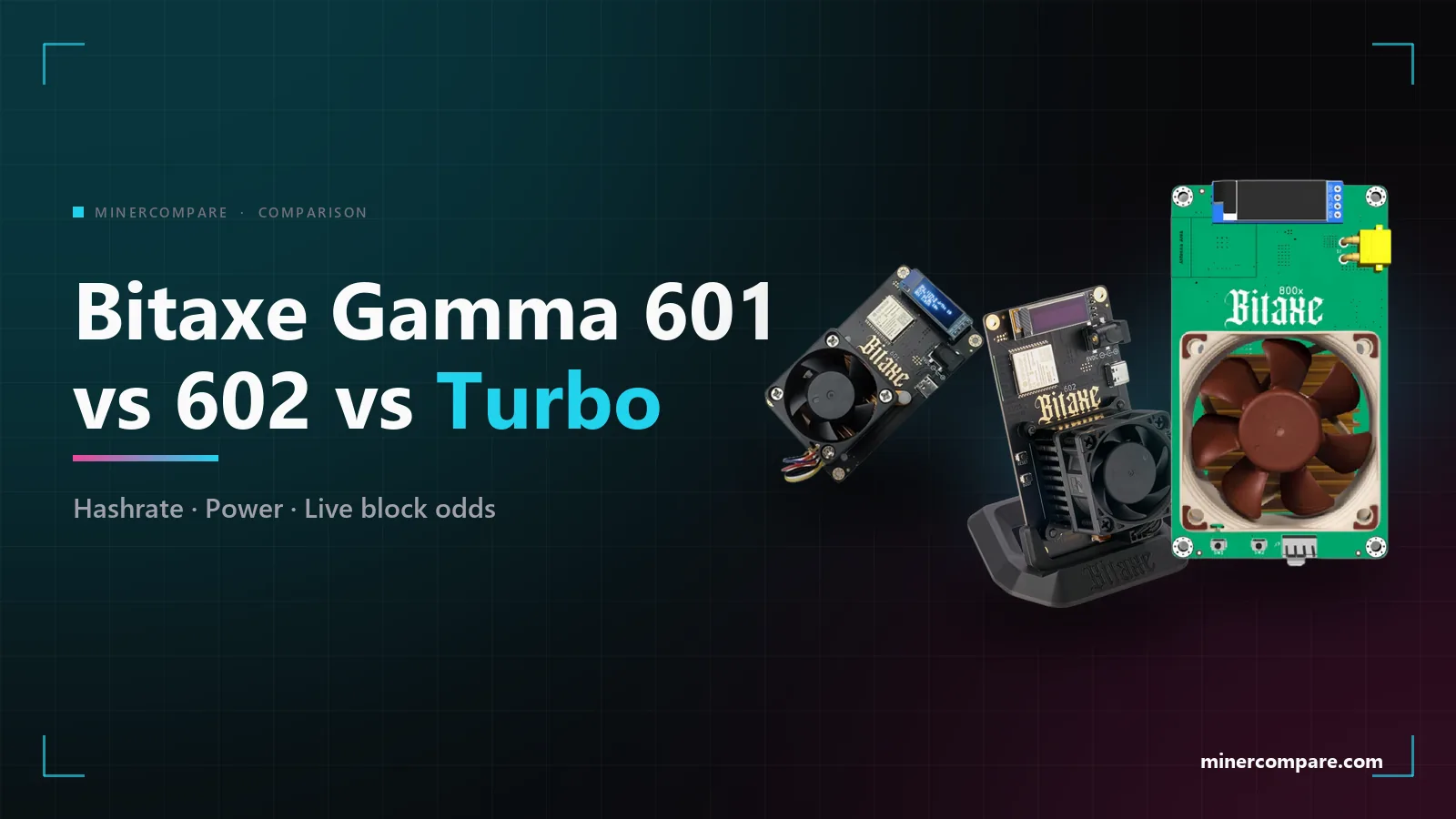
Three Bitaxe boards share one chip family and one job: to buy you a cheap lottery ticket in every Bitcoin block draw. The Gamma 601, the Gamma 602 and the Gamma Turbo differ in hashrate, power draw and price, and the right pick depends on how many tickets per second you want and what you are willing to pay in electricity for them. This comparison puts the three side by side with live odds, written as one in N and never as a profit promise.
The short answer
Buy the Gamma 602 if you want the reference single-chip board in its newest form. It lists a little more hashrate than the 601 for a little less power, so it buys its tickets slightly cheaper.
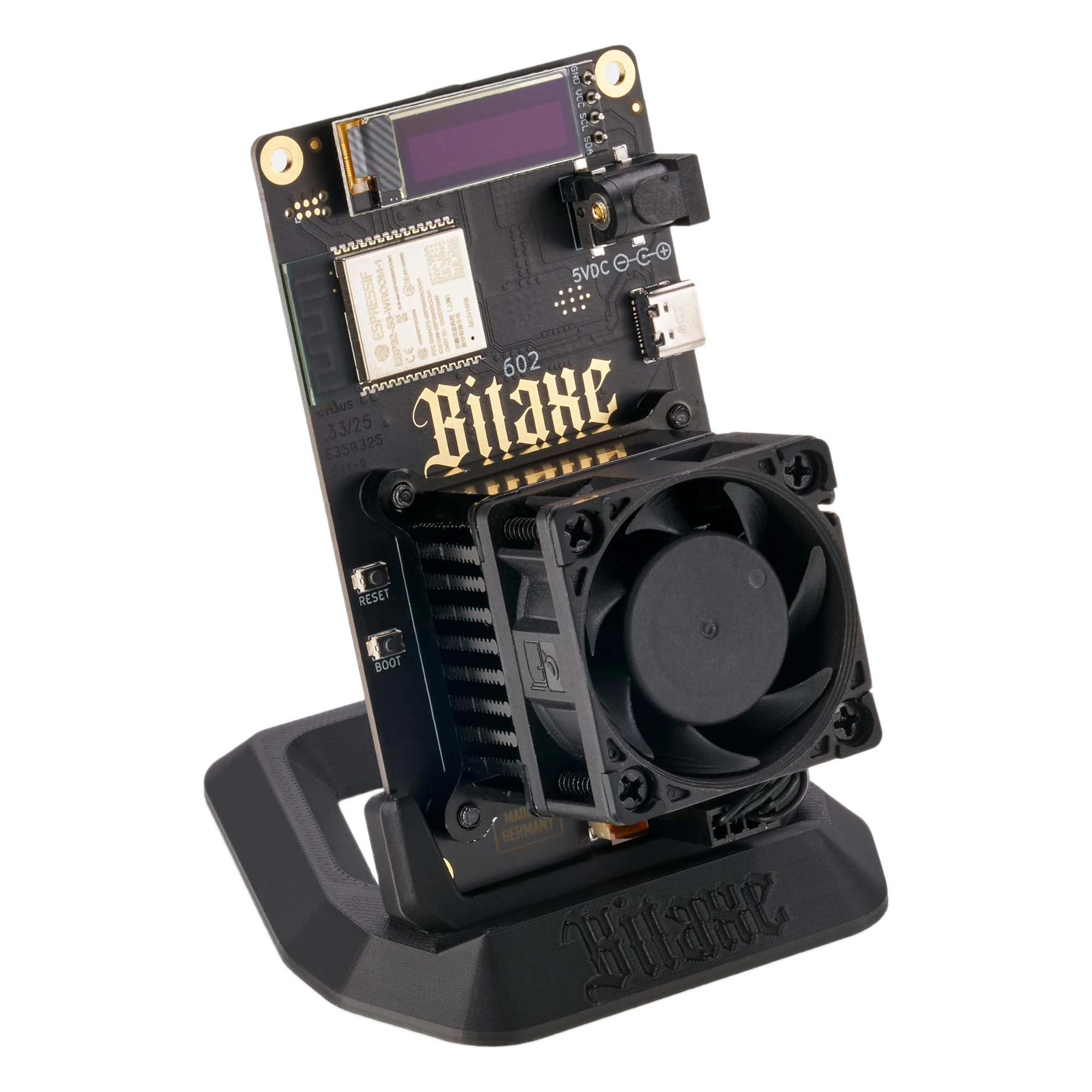 Bitaxe Gamma 602 (1.3TH)
Buy the Gamma Turbo if you want twice the tickets from a board that is still desk-sized. It carries two chips, so hashrate and power both roughly double, and the odds improve by the same factor.
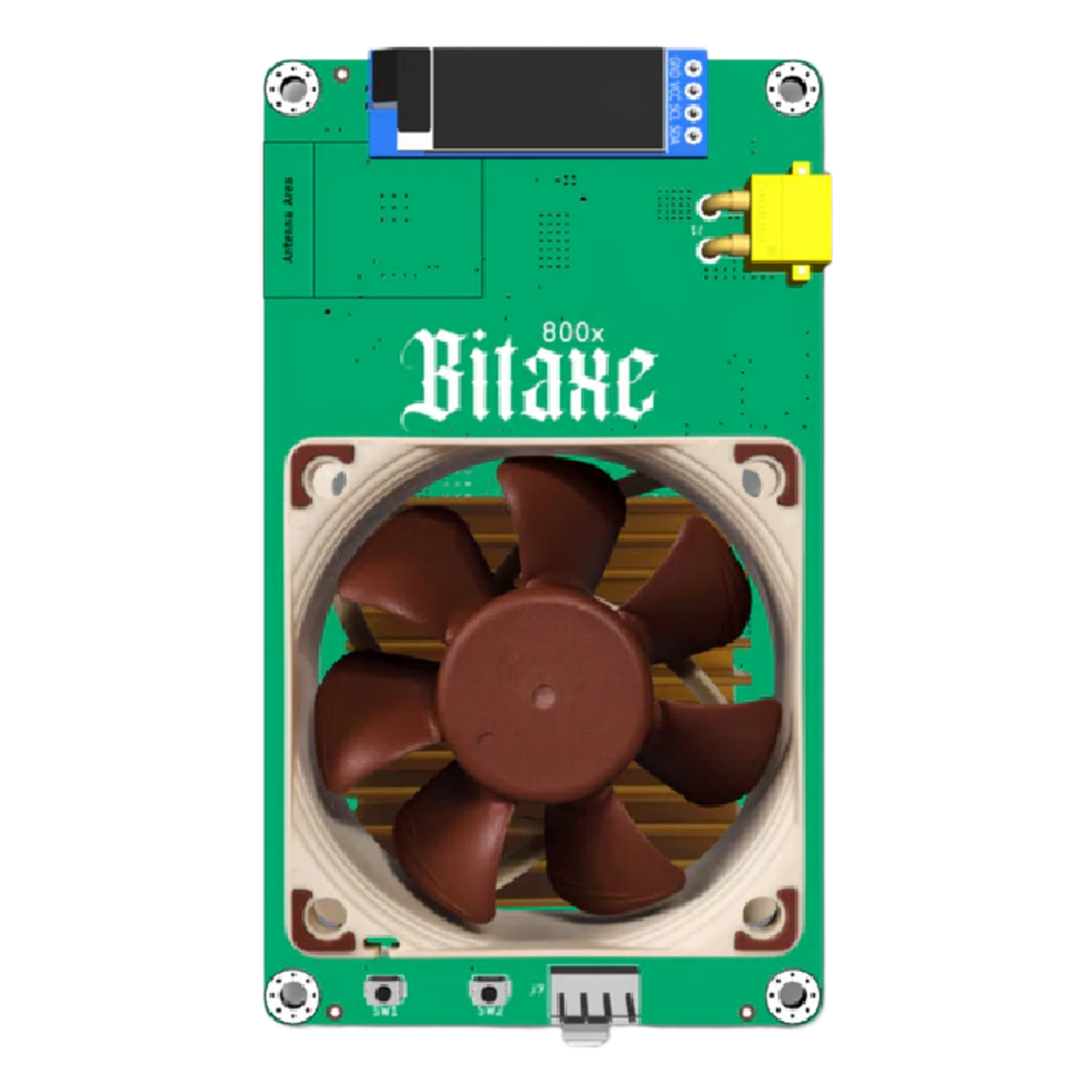 Bitaxe Gamma Turbo (2.4TH)
Buy the Gamma 601 only if it is the one in stock at a good price. It is the board that started the movement and it still works exactly as designed, but the 602 has overtaken it on paper.
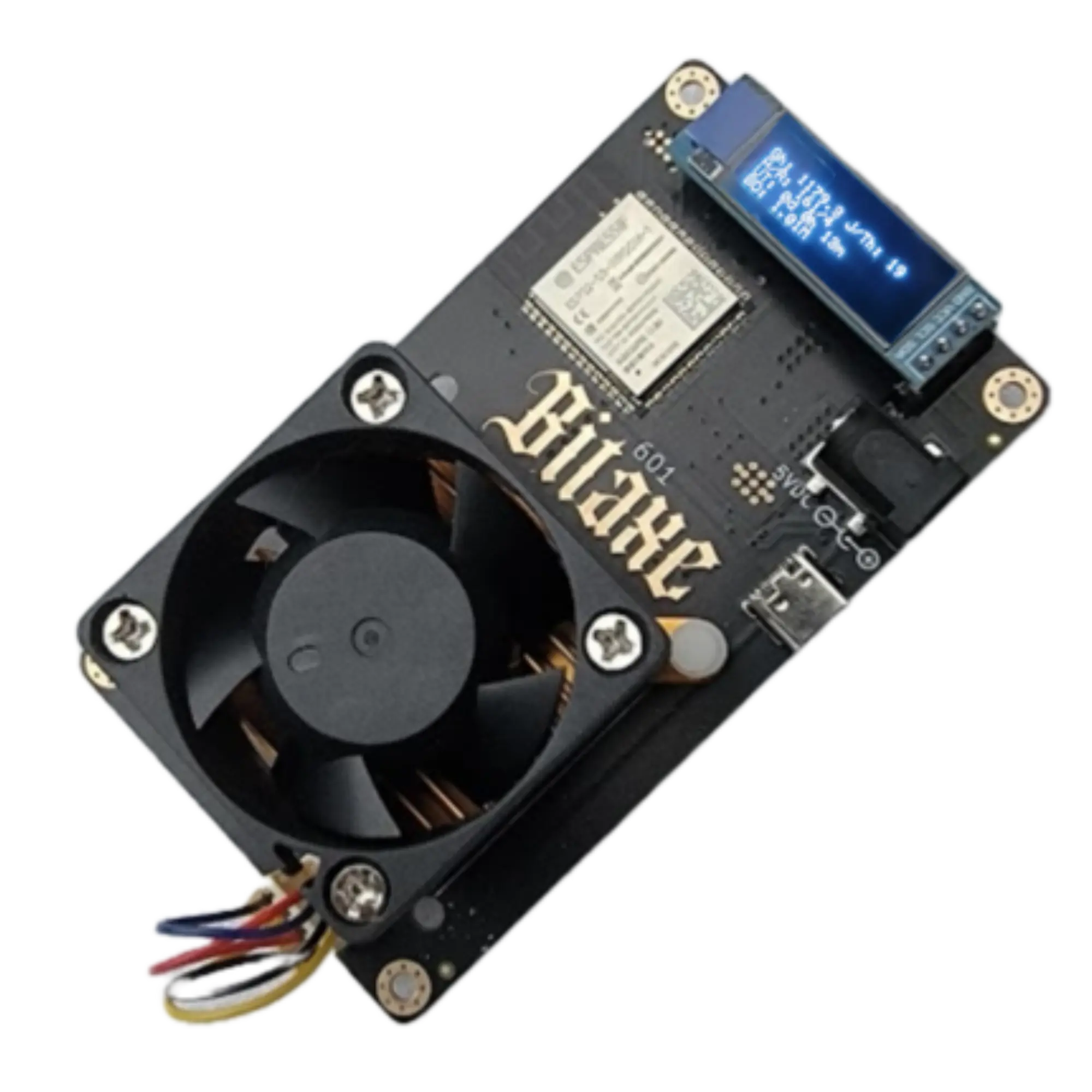 Bitaxe Gamma 601 (1.2TH)
Three boards, one chip family
All three are built around the Bitmain BM1370, the chip used in the Antminer S21 Pro. The 601 and the 602 carry one of them, the Turbo carries two, and all three run the open AxeOS firmware that lets you point the board at any solo pool or at your own node.
| Model | Hashrate | Power | Chips |
|---|---|---|---|
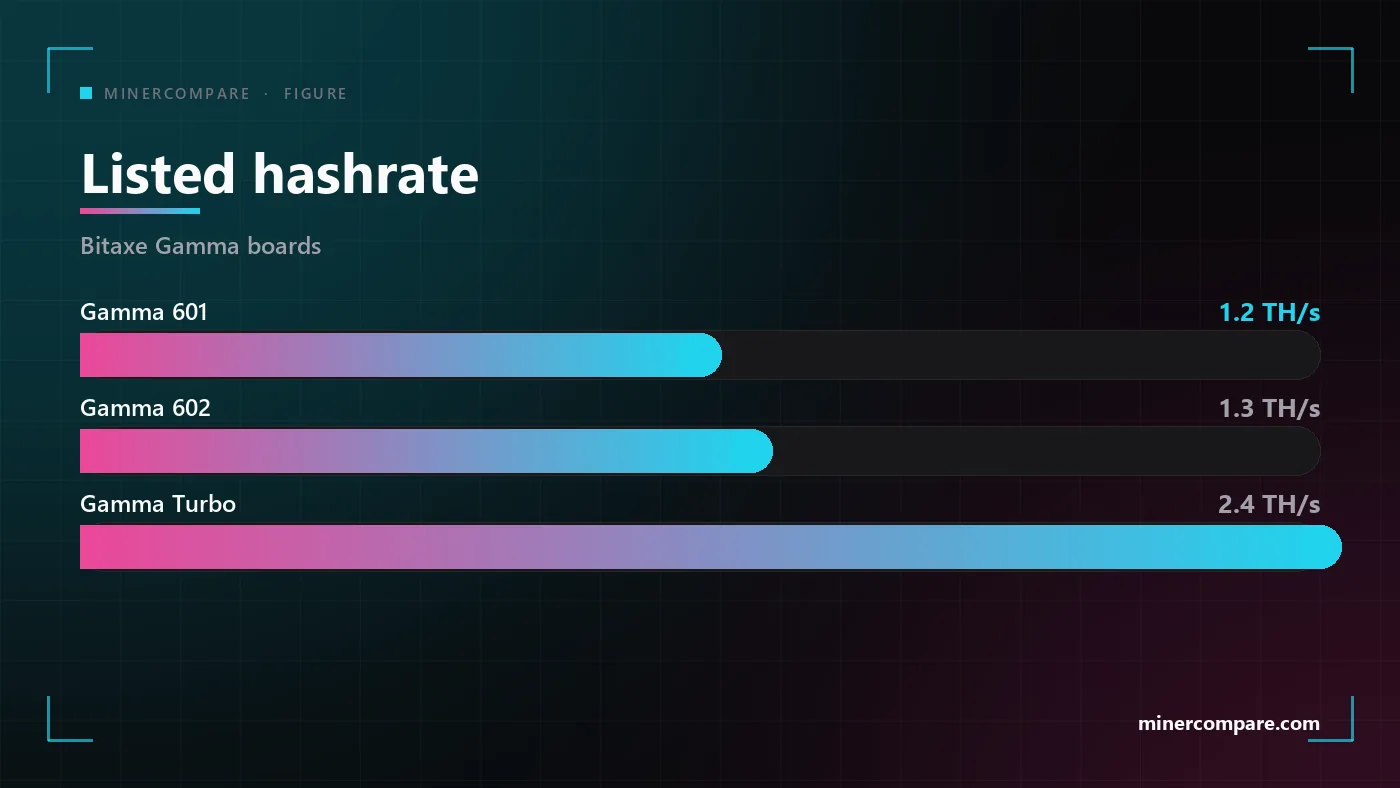
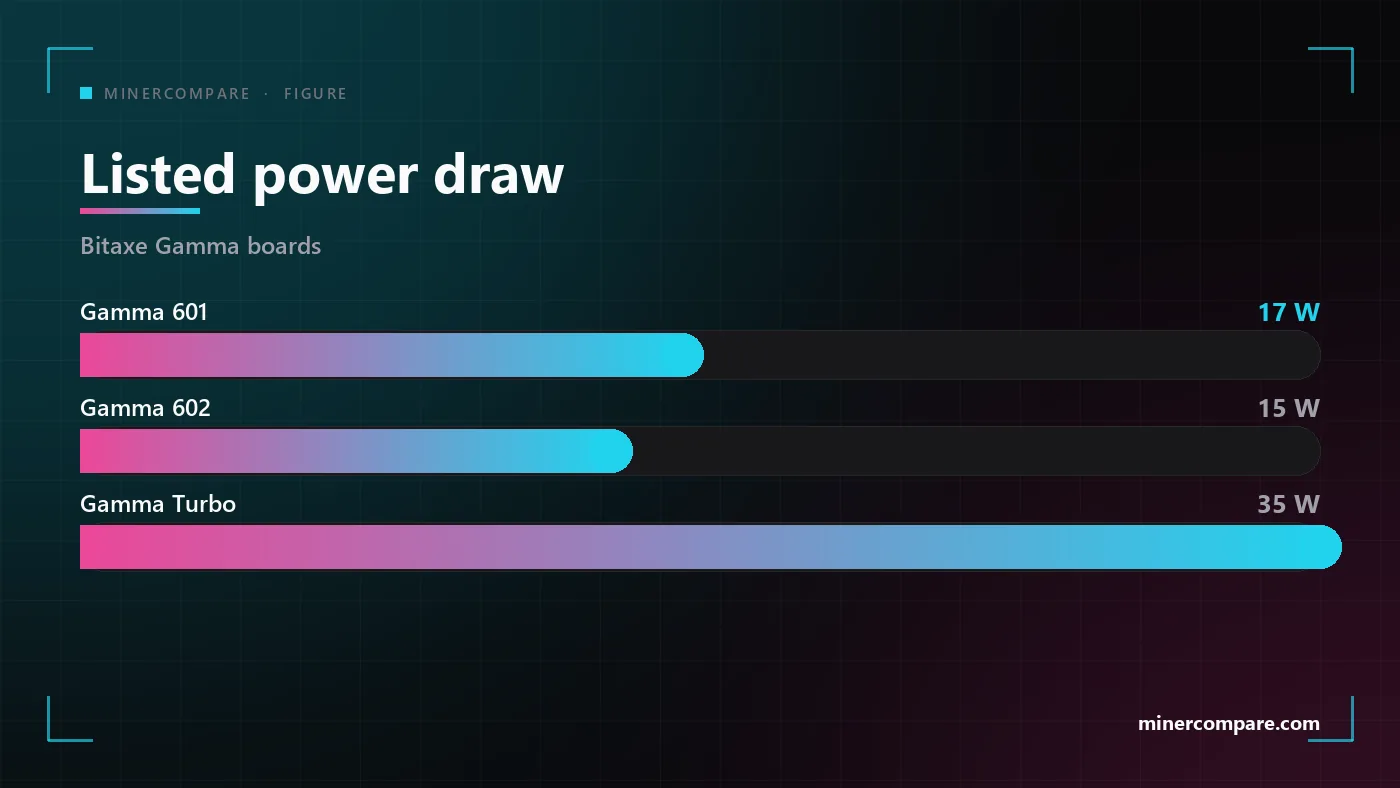
| Bitaxe Gamma 601 | 1.2 TH/s | 17 W | 1 |
| Bitaxe Gamma 602 | 1.3 TH/s | 15 W | 1 |
| Bitaxe Gamma Turbo | 2.4 TH/s | 35 W | 2 |
Sellers describe the same boards with slightly different numbers, because the hashrate depends on the frequency and voltage a board is tuned to. For a fair comparison use the live odds below, and treat any single figure on a product page as a typical value.
Gamma 601: the board that started it
The Gamma 601 is the reference single-chip Bitaxe, released in August 2024. It brought the BM1370 to a palm-sized open-source board and made Bitcoin lottery mining a mainstream hobby. About 1.2 TH/s from roughly 17 W is still a fair ticket.
It runs quietly enough to stay on a desk, connects over WiFi, and its design is open, so parts and firmware are widely documented. Its only weakness is that newer boards have caught up with it on paper.
Gamma 602: the same board, tuned
The Gamma 602 keeps the single BM1370 and the compact form factor, and trims the power. Our database lists it at about 1.3 TH/s from roughly 15 W, a little more work for a little less electricity than the 601.
That is a small gain, not a new class of machine. Retailers sell several revisions of the Gamma under similar names, so check the exact revision and the seller before you pay, and compare the numbers on the product page with the ones above.
Gamma Turbo: twice the tickets
The Gamma Turbo puts two BM1370 chips on a board that is still desk-sized. It lists about 2.4 TH/s from roughly 35 W on a 12 V supply, and sellers quote anything from 2.2 to 2.5 TH/s depending on tuning. Hashrate and power both roughly double compared with the single-chip boards.
Doubling the hashrate doubles your share of every block draw. It does not make a block likely, only twice as likely as before, and the electricity bill rises in proportion. That is a fair trade for someone who wants the best ticket a Bitaxe can buy without stepping up to a larger multi-chip machine.
What the odds look like
The odds below are calculated from each hashrate against the current Bitcoin network difficulty. They are written as one in N and they move whenever the network does, so this table is always current.
| Model | Daily block odds | Yearly block odds | Electricity per year (0.10 USD/kWh) |
|---|---|---|---|
| Bitaxe Gamma 601 | 1 in 5.5M | 1 in 15.1K | $15 |
| Bitaxe Gamma 602 | 1 in 5.07M | 1 in 13.9K | $13 |
| Bitaxe Gamma Turbo | 1 in 2.75M | 1 in 7.53K | $31 |
Read the yearly column as the honest picture: even the Turbo stays a long shot, and the three boards differ by a factor of two at most. What you are really choosing is how much electricity you spend per ticket.
Which one should you buy?
You want the cheapest way in
Take the Gamma 602, or a 601 on sale. Either one puts a real ticket in every block draw for the price of a small appliance and a few dollars of electricity a year.
You want the most tickets on a desk
Take the Gamma Turbo. It doubles your share without leaving the Bitaxe form factor or the open firmware.
You want to run several boards
Each board is a separate ticket and the odds add up. Two single-chip boards give roughly the odds of one Turbo, so price per board and free sockets decide.
You want a serious jump in odds
Look at the multi-chip boards on the solo lottery page, where the yearly odds are many times better than any single Bitaxe.
The solo lottery page lists every lottery miner we track for both algorithms, rated by daily block odds, with your electricity rate applied as the yearly ticket price.
See every solo miner with live oddsHeat, noise and placement
Keep a Bitaxe in open air, with space around the fan and the heatsink. A fan moves air over the chip, so a cramped shelf, a closed drawer or a pile of cables behind the board raises the temperature and makes the fan work harder.
The single-chip boards are quiet enough for a desk. The Turbo carries a second chip and gives off more heat, so give it more room and expect its fan to be the more audible of the three.
Every watt a Bitaxe draws ends up as heat in the room. The draw is small next to a heater or a gaming PC, so the board warms its corner of the desk and not the whole room.
Dust works against you over the months, so blow out the fan and the heatsink from time to time, and keep the board away from a window that gets direct sun.
Power supply and WiFi
Use the power supply the seller specifies for your board, and choose one with some headroom. The Gamma Turbo is listed on a 12 V supply. A supply that cannot deliver the current a board asks for causes resets that look like a firmware fault.
A Bitaxe connects over WiFi, so a weak signal shows up as missing or rejected shares and not as an obvious error. Place the board where the signal is solid, and check the shares and the uptime on the AxeOS page after the first day.
A board that restarts at random is almost always a power or WiFi problem and not a broken chip. Check the supply and the signal first, and only then look at the settings.
Common mistakes when buying
Most disappointments with a Bitaxe come from expecting the wrong thing or from skipping a simple check, not from the board itself.
- Treating it as income. A Bitaxe buys a ticket in every block draw. The odds stay long on every model, so count the electricity as the price of the ticket.
- Skipping the revision check. Similar names cover several revisions, so ask the seller which one you get and compare its hashrate and power with the table above.
- Buying on the biggest advertised hashrate. Hashrate depends on how a board is tuned, so a bigger number on a product page is not a better board. Compare hashrate and power together.
- Ignoring the pool settings. A pool whose difficulty floor is too high for a one-terahash board can leave it disconnected or without shares. Read the pool guide before the first day.
- Overclocking on day one. A higher frequency adds hashrate and heat together. Start on the default settings and change one thing at a time.
What to do after you buy
Point the board at a solo pool whose difficulty floor it can clear, and add a second solo pool as backup. The pool guide below lists the exact settings, and the setup guide walks through power, network and cooling for any ASIC miner.
Our solo mining calculator takes your own hashrate and power and shows the odds per day, month and year, so you can test a board before you buy it. Solo Mining Calculator: Block Odds for Your Miner
These articles and pages cover the next steps. Solo Mining Bitcoin With a Bitaxe: Low-Difficulty Pools, Primary and Backup Settings · How to Set Up an ASIC Miner: Power, Network, Pool and Cooling, Step by Step · Bitcoin Home Mining in 2026: How Solo Lottery Miners Work and Which One to Buy · Compare Miners · Crypto Mining Pools
Bottom line
The 602 is the efficient pick, the Turbo is the strong pick, and the 601 is the one to take if the price is right. None of them changes the nature of the game: a Bitaxe is a lottery ticket that costs very little to keep in the draw.
Choose by electricity per ticket and by how many tickets you want, check the revision with the seller, and then let the live odds on this site do the rest.