English
 German
 Hungarian
 Dutch
Dutch
 Spanish
 French
 Italian
 Czech
Czech
 Polish
 Greek
Greek
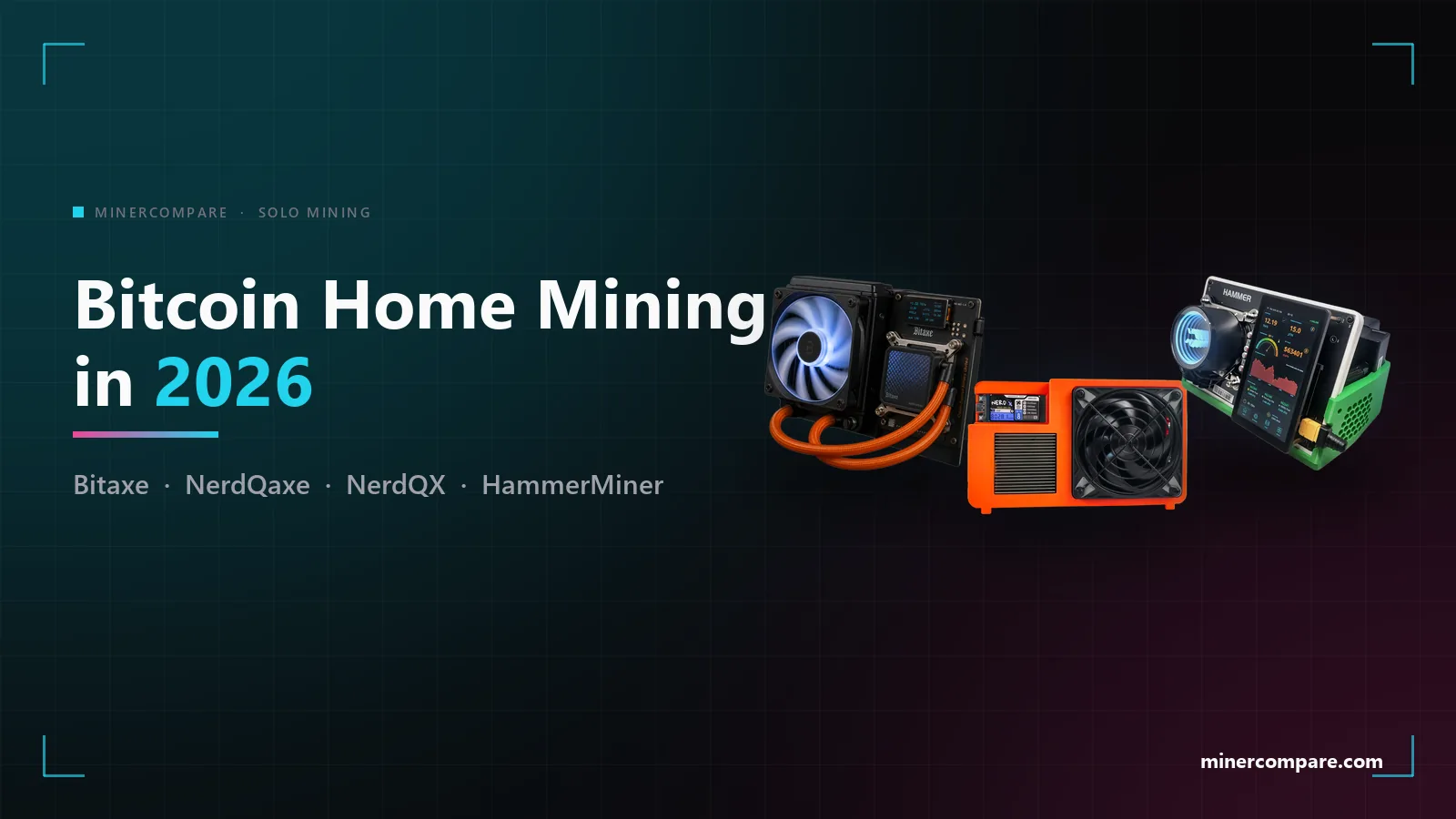
Two years ago, mining Bitcoin at home meant a loud shoebox drawing three kilowatts and a very patient family. In 2026 it means a device the size of a paperback on a shelf, drawing less power than a desk lamp, quietly buying one lottery ticket per second. This guide explains how that lottery works, what the odds actually are at each hashrate tier, how to pick a machine for your room and your electricity rate, and how to set it up without wasting tickets.
What a solo lottery miner is
A solo lottery miner is an ordinary SHA-256 ASIC, just a very small one. Instead of pooling its work with thousands of other machines and taking a proportional slice of every block the pool finds, it works on its own: it asks a solo pool for the current block template, hashes against it, and if one of its hashes is below the network target the whole block is yours. There is no in-between reward. Either the miner finds a block and your address receives the full subsidy plus the transaction fees, or it finds nothing and you have paid for electricity.
The machines in this article all use the same chip family as the big Antminers, the Bitmain BM1370, but one, four or eight of them instead of a few hundred. That is why they hash at 1 to 12 terahashes per second while an industrial unit hashes at 200 or more, and why they can live on a desk. Every one of them is open source or built around open firmware, connects over Wi-Fi, and is configured from a web page in your browser.
Four of them define the range people actually buy in 2026, and MinerCompare tracks all four with live odds:
-
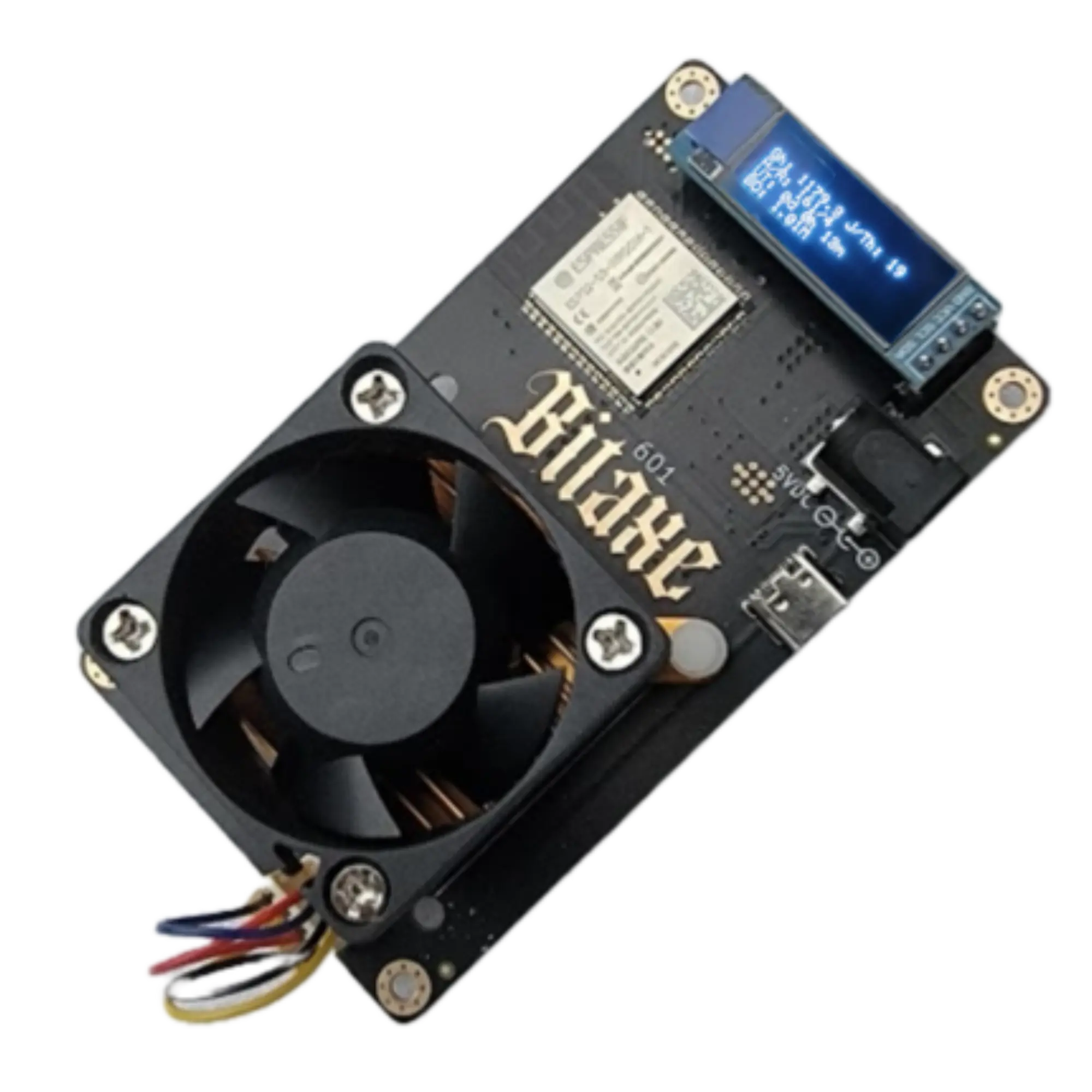 Bitaxe Gamma 601 (1.2TH)
— one BM1370, the original desk miner, the cheapest ticket in the draw.
Bitaxe Gamma 601 (1.2TH)
— one BM1370, the original desk miner, the cheapest ticket in the draw. -
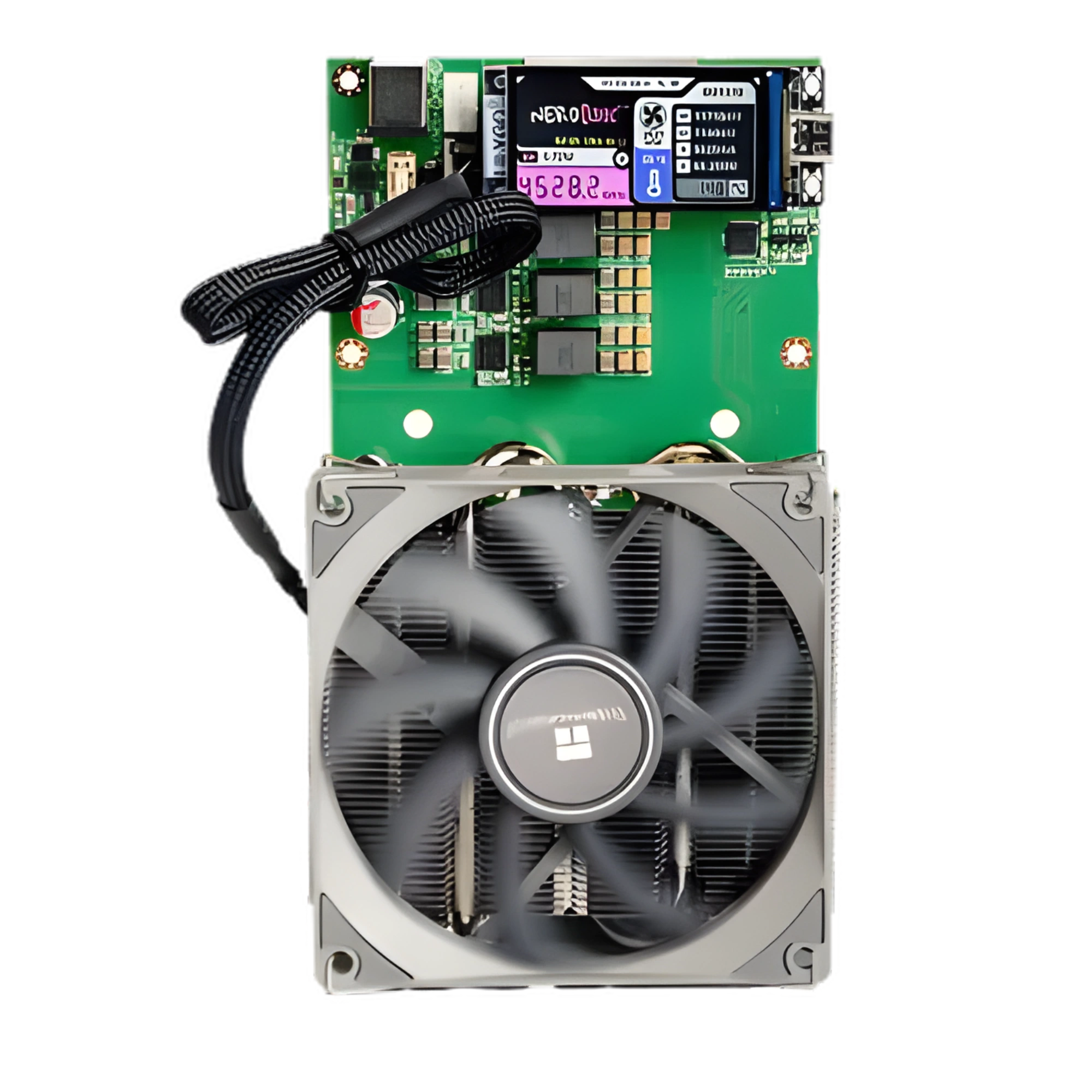 NerdMiner NerdQaxe Plus Plus (4.8TH)
— four BM1370 chips on one board, the most popular mid-tier machine.
NerdMiner NerdQaxe Plus Plus (4.8TH)
— four BM1370 chips on one board, the most popular mid-tier machine. -
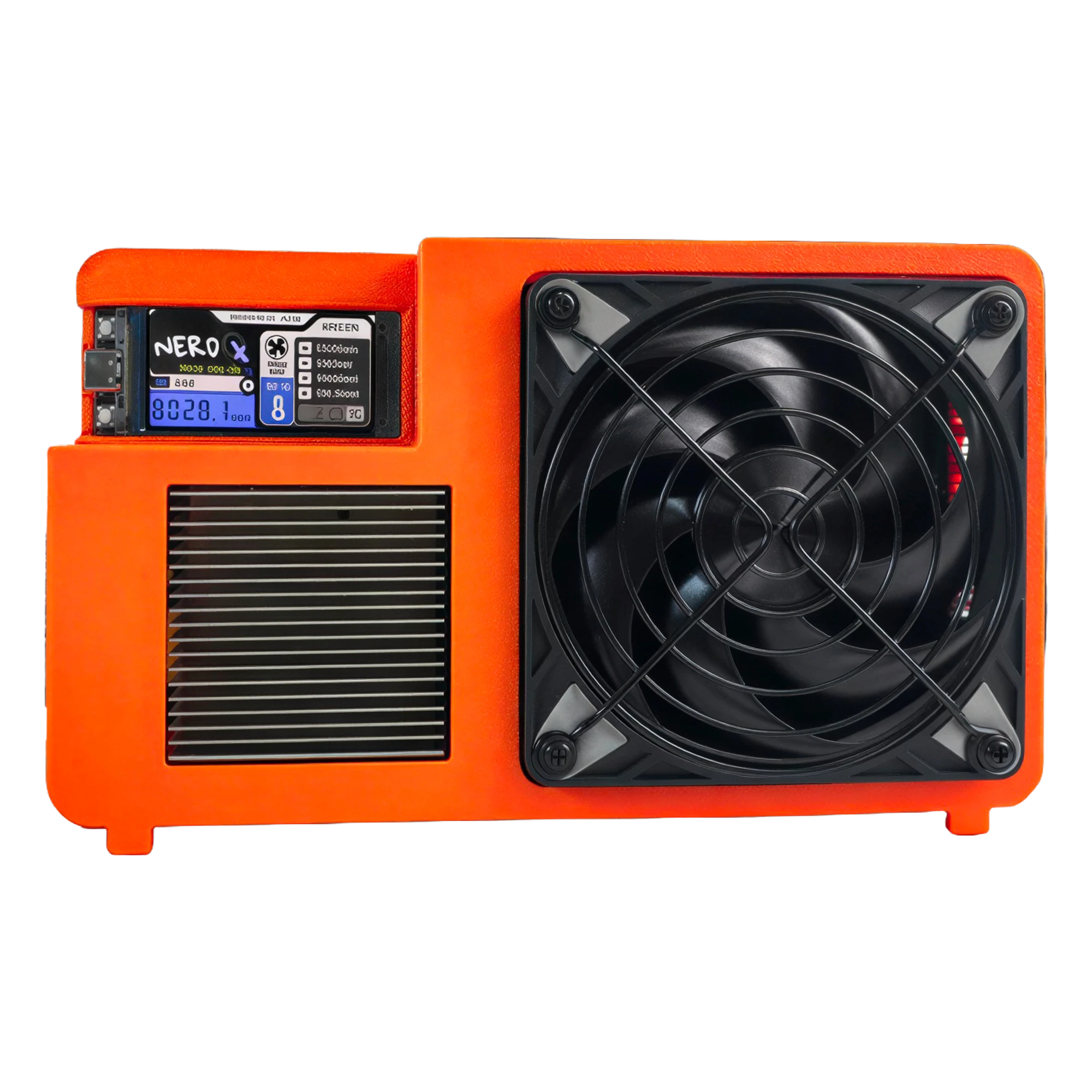 NerdMiner NerdQX (8TH)
— the same four chips driven harder, with a bigger heatsink and fan.
NerdMiner NerdQX (8TH)
— the same four chips driven harder, with a bigger heatsink and fan. -
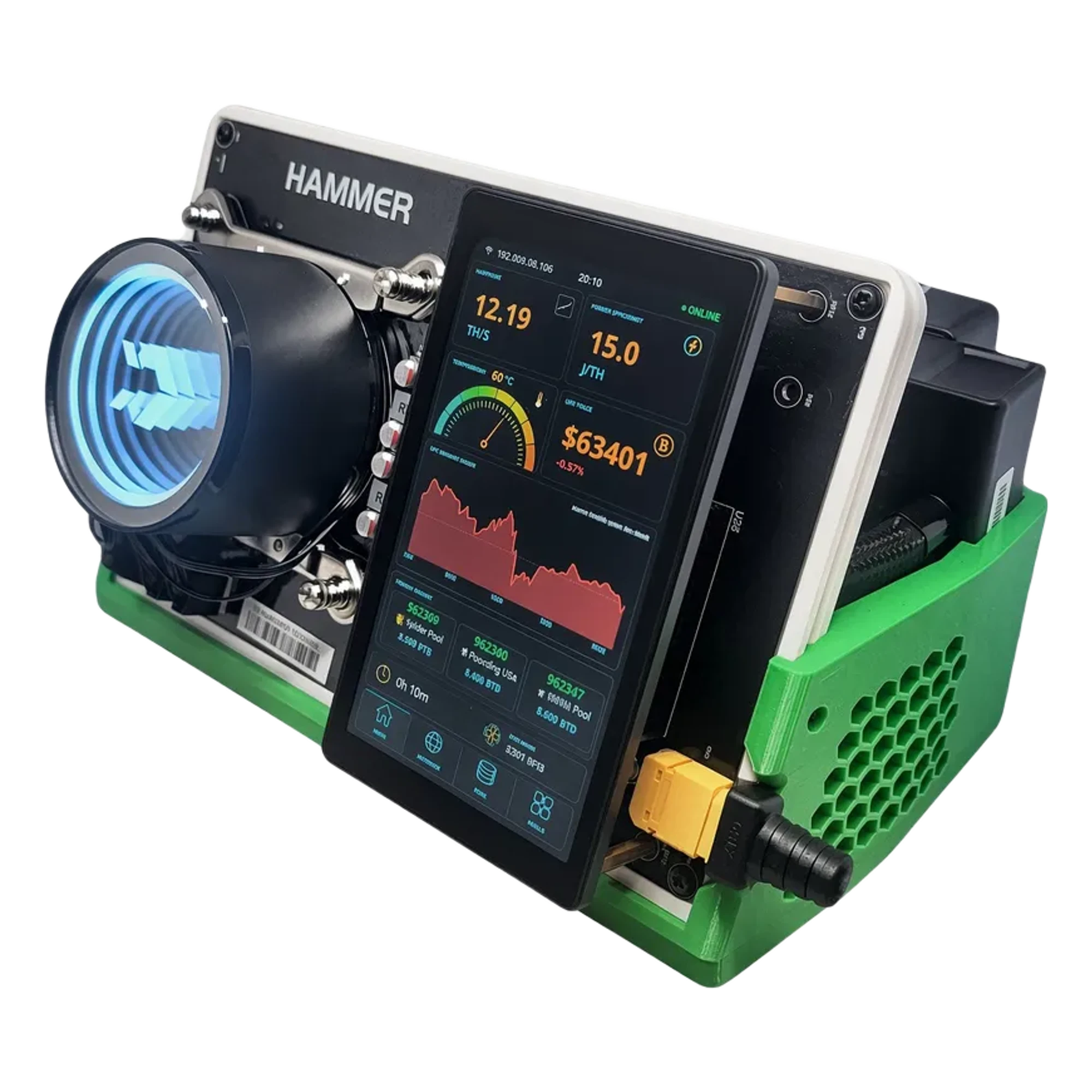 HammerMiner BC08 (12TH)
— eight chips in a proper case, the top of the home tier.
HammerMiner BC08 (12TH)
— eight chips in a proper case, the top of the home tier.
How the odds work
The maths is short. Your chance of finding any given block is your hashrate divided by the whole network's hashrate. Bitcoin produces a block roughly every ten minutes, so there are about 144 draws a day, and your daily chance is that share multiplied by 144. Monthly and yearly figures are the same share multiplied by the number of blocks in a month or a year. There is no memory between draws: a miner that has run for three years without a block has exactly the same chance tomorrow as one unboxed today.
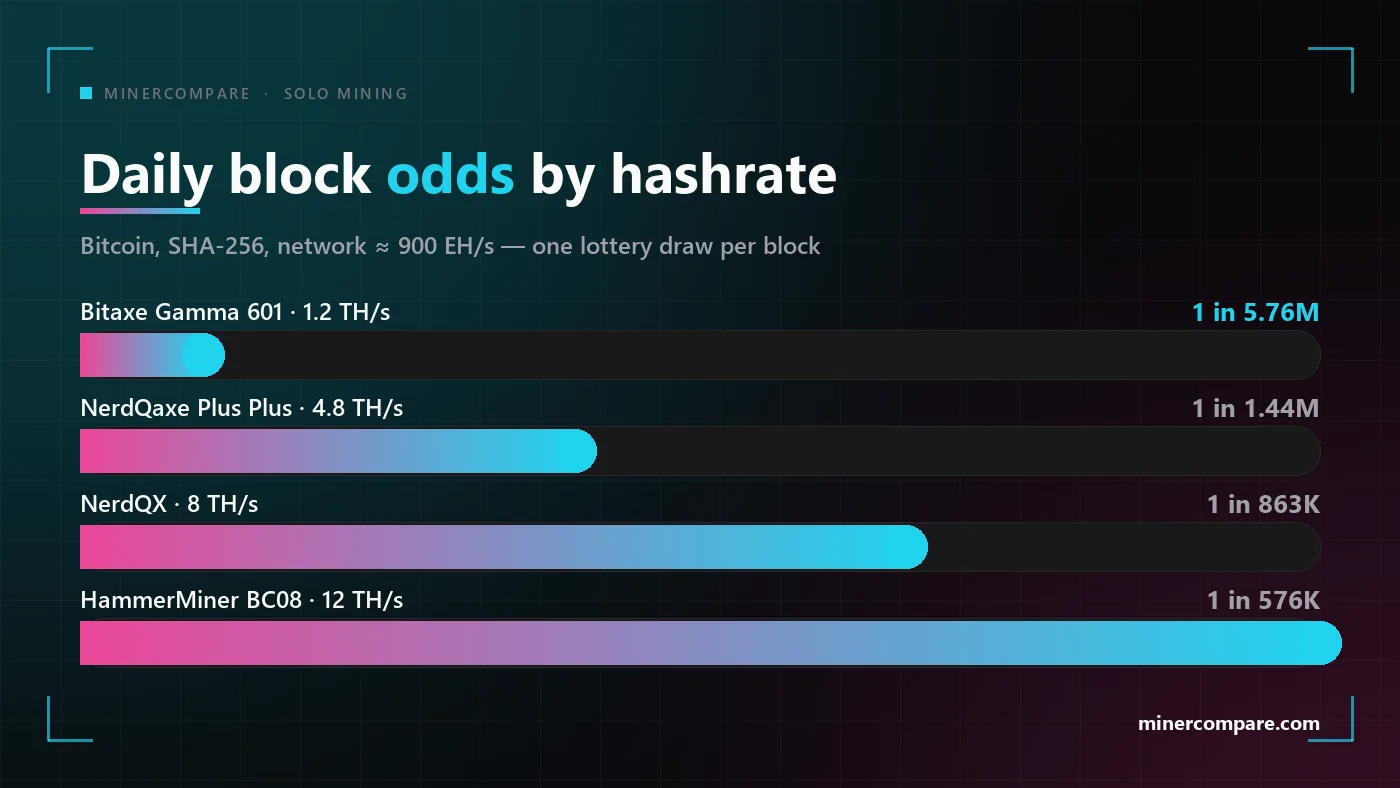
At the time of writing the network is hashing at roughly 900 exahashes per second. Against that, the four machines above line up like this:
| Miner | Hashrate | Odds per day | Odds per year |
|---|---|---|---|
| Bitaxe Gamma 601 | 1.2 TH/s | 1 in 5.76M | 1 in 15.8K |
| NerdQaxe Plus Plus | 4.8 TH/s | 1 in 1.44M | 1 in 3.94K |
| NerdQX | 8 TH/s | 1 in 863K | 1 in 2.36K |
| HammerMiner BC08 | 12 TH/s | 1 in 576K | 1 in 1.58K |
Read the yearly column first, because that is the horizon a hobby runs on. A single Bitaxe has about a 1 in 16,000 chance of a block in a year of continuous running; a BC08 has about 1 in 1,600. Ten Bitaxes on a shelf have the same odds as one BC08, because odds add up linearly with hashrate. That linearity is the most useful fact in solo mining: there is no bonus for being big and no penalty for being small, only the ticket count.
The prize is the block reward, 3.125 BTC since the April 2024 halving, plus whatever fees are in the block, which on a normal day adds a few percent and on a busy day considerably more. At current prices that is well over two hundred thousand dollars, paid in one transaction to the address you typed into the miner. That asymmetry, a ticket that costs cents against a prize that buys a house, is why the hobby exists.
Electricity is the ticket price
Since there is no daily income, the only cost that matters after the purchase is electricity, and it is best thought of as the price of the tickets. A Bitaxe Gamma draws about 17 watts, which is roughly 0.4 kilowatt-hours a day. At a European rate of 30 cents per kilowatt-hour that is 12 cents a day, or about 45 dollars a year for a 1 in 16,000 shot. A BC08 at 250 watts is 6 kilowatt-hours a day, about 1.80 a day and 650 a year at the same rate, for a 1 in 1,600 shot.
Notice that the price per unit of odds is almost the same across the range, because both the ticket count and the power draw scale with the chip count. What changes is the absolute bill and the heat. A machine that costs 45 dollars a year to run can sit in a bedroom and be forgotten; one that costs 650 a year and pushes 250 watts of warm air into a room is a deliberate choice, and in summer it is a fan-and-window choice.
This is also why electricity rate matters more than purchase price over the life of the machine. Enter your own rate on any miner page and the solo panel will show block value against your yearly electricity cost side by side, which is the honest way to look at it: how much are you paying per year for that many tickets, and are you comfortable with that as the cost of a hobby that will most likely pay nothing.
The three tiers of desk miners
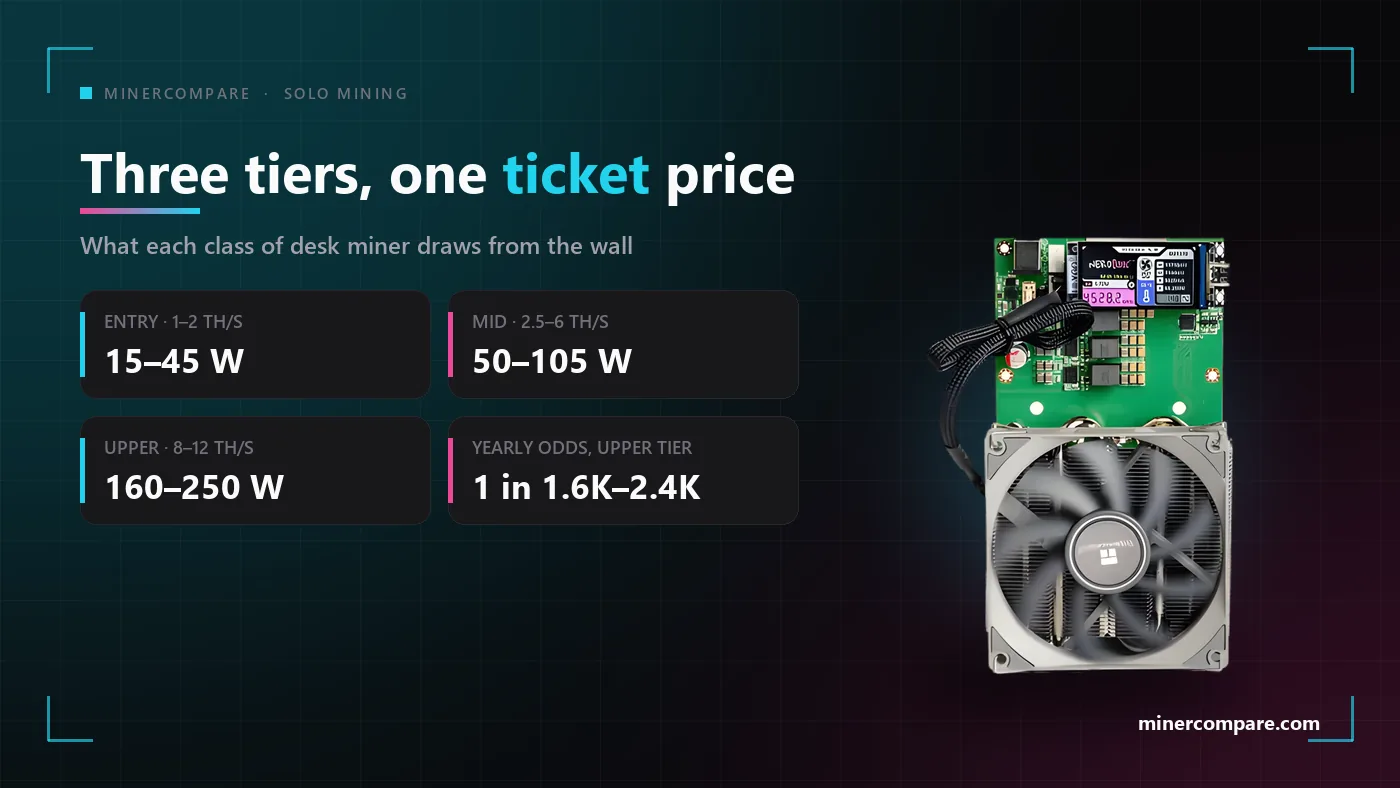
Entry: one chip, 1 to 2 TH/s, 15 to 45 W
The Bitaxe Gamma family is the entry tier and still the one most people start with. One BM1370, a small fan, a tiny screen, a 5 volt barrel supply, and AxeOS, the open firmware that lets you set frequency and core voltage from a browser tab. The Gamma 601 ships around 1.2 TH/s and can be pushed higher with a better fan and more voltage; the 602 revision and the touch-screen variants are the same idea with nicer hardware. It is silent enough for a bedroom shelf and cheap enough to buy as a gift, and because everything is open source there is a large community of case designs, firmware forks and dashboards.
Mid: four chips, 2.5 to 6 TH/s, 50 to 105 W
The NerdQaxe Plus Plus put four BM1370 chips on one board and became the default mid-tier machine almost overnight. At stock settings it hashes about 4.8 TH/s at roughly 76 watts, four times the tickets of a Gamma for about four times the power, in a footprint that is barely bigger. It runs the same AxeOS-derived firmware, so a Bitaxe owner already knows how to configure it. The hydro revision swaps the fan for a small water loop and is the one to pick if the machine will sit near a desk you work at all day.
Upper: four to eight chips, 8 to 12 TH/s, 160 to 250 W
At the top of the home tier are two different approaches to the same number. The NerdQX takes the same four chips and drives them hard, with a large heatsink and a real fan, to reach 8 TH/s at 170 watts. The HammerMiner BC08 takes eight chips at a gentler clock, puts them in a finished case with Ethernet as well as Wi-Fi, multiple power modes and a warranty, and reaches 12 TH/s at 250 watts. Both are audible in a quiet room and both warm it. They are the point where a solo miner stops being a gadget and starts being a small appliance, and where the yearly odds move from thousands to the low thousands.
The solo lottery page lists every lottery miner we track, rated by daily block odds and filtered by network, with your electricity rate applied.
See every solo miner with live oddsPicking one for your room
Because the odds per watt are nearly flat across the range, the choice is not really about odds. It is about three practical things: where the machine will live, what you pay for power, and whether you want one big ticket count or several small ones.
If the machine will sit where people sleep or work, stay in the entry tier or pick a hydro model. Fans on the upper tier are not loud by ASIC standards, but they are loud by bedroom standards, and the heat is noticeable in a small room. If it will live in a garage, a utility room or next to a router in a hallway, the upper tier is fine and the bill is the only question.
If your electricity is expensive, above 30 cents per kilowatt-hour, treat the yearly running cost as the real price of the machine and size the tier to the amount you are happy to spend on a lottery ticket each year. If it is cheap, below 10 cents, the running cost barely matters and the purchase price and noise decide. Several small machines in different rooms spread the heat and let you experiment with firmware and cases; one large machine is simpler to manage and usually cheaper per terahash when bought new.
If the question is really whether to spend the same money on a pool miner instead, our guide to buying an ASIC miner walks through how vendor offers, delivered prices and payback are shown, and the Antminer S21 class on the SHA-256 list is the reference for what a pool machine earns at your rate. Buying an ASIC Miner · SHA-256 miners · Bitcoin coin page
Setup in ten minutes
All four machines set up the same way, because they all run AxeOS or a close relative of it. There is no software to install on your computer and no account to create anywhere except at the pool.
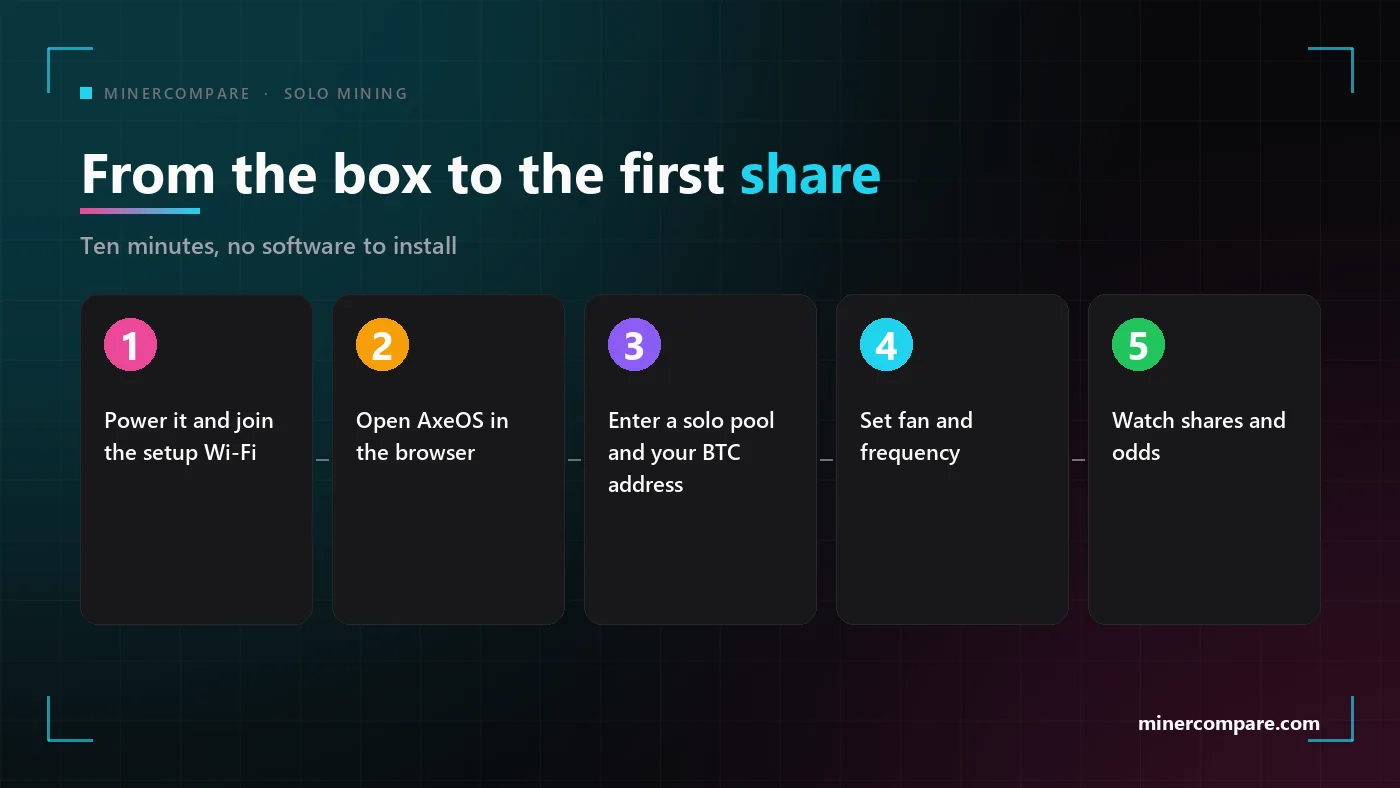
Power it and join its setup network
On first boot the miner broadcasts its own Wi-Fi network. Connect a phone or laptop to it, open the address on the screen, and enter your home Wi-Fi name and password.
Open the dashboard on your home network
After it reconnects, the miner's new address is shown on its screen and in your router's device list. The dashboard shows hashrate, temperature, fan speed and best share.
Enter a solo pool and your Bitcoin address
In the pool settings, type the solo pool's stratum address and port, and use your own Bitcoin receiving address as the username. That address is where a found block is paid.
Set fan and frequency
Leave the stock frequency for the first day and watch temperatures. A fixed fan speed around 60 percent is quieter than automatic on most units and keeps the chips well under their limit.
Watch shares and odds
Within a minute the share counter should climb and the pool's worker page should show your miner. From then on the only thing to check is that it keeps hashing.
Two details matter more than they look. First, the Bitcoin address must be one you control, from a wallet whose seed phrase you have backed up; a block paid to an exchange deposit address or a wallet you have since deleted is a block lost. Second, use a solo pool that shows your best share, because that is the only proof that your tickets are being counted. A miner that hashes but whose shares never reach the pool is buying tickets and throwing them away.
Mistakes that waste tickets
Most of the ways to lose in solo mining are not bad luck, they are unforced errors, and the same few come up again and again.
- Pointing the miner at a normal pool by accident. A pay-per-share pool will happily accept a Bitaxe and pay it a few cents a day, which is not what you bought it for. Check that the pool address is a solo endpoint.
- Overclocking for a bigger number on the screen. A chip pushed past its stable frequency produces hardware errors that are not valid shares, so the reported hashrate rises while the real ticket count falls. Watch the rejected share count, not the hashrate.
- Letting it overheat in summer. AxeOS throttles or shuts down above its temperature limit, and a miner that is off for six weeks of heat has lost a sixth of its yearly odds. A fan curve and a shelf with airflow cost nothing.
- Cheap power supplies. Most entry machines ship with a supply that is barely adequate at stock settings and inadequate after any overclock. A brown-out reboots the miner, and every reboot is a few minutes of tickets not bought.
- Forgetting it exists. A Wi-Fi password change, a router replacement or an unplugged extension lead can take a miner offline for months unnoticed. The pool's worker page or a home dashboard that alerts on silence is worth setting up on day one.
If the lottery framing appeals but Bitcoin does not, the same kind of machines exist for Litecoin and Dogecoin on Scrypt, where one block pays both coins; and if you would rather have steady income from a graphics card you already own, read our honest look at GPU mining this year. Is GPU mining back in 2026? · Scrypt miners
Bottom line
A home solo miner is a lottery ticket that renews itself every ten minutes for as long as you pay the electricity, with a prize of one whole Bitcoin block. The odds scale exactly with hashrate and so does the power bill, so the decision is not which machine gives better odds per watt, they all give about the same, but how many tickets you want to buy per year and how much heat and noise you will accept to buy them.
Start with a Bitaxe if you want to learn what the hobby is and keep the bill invisible. Move to a NerdQaxe Plus Plus when you know you will keep it running and want a meaningful ticket count in a small box. Go to a NerdQX or a HammerMiner BC08 when you have a room that can take the heat and you want yearly odds in the low thousands. Whatever you pick, put it on a solo pool, use an address you own, and check the pool once a week. The rest is up to the block.
Flip the solo switch on the ASIC list to see only lottery miners, rated by odds per day, next to every offer we track.
Browse all ASIC miners