English
 German
 Hungarian
 Dutch
Dutch
 Spanish
 French
 Italian
 Czech
Czech
 Polish
 Greek
Greek
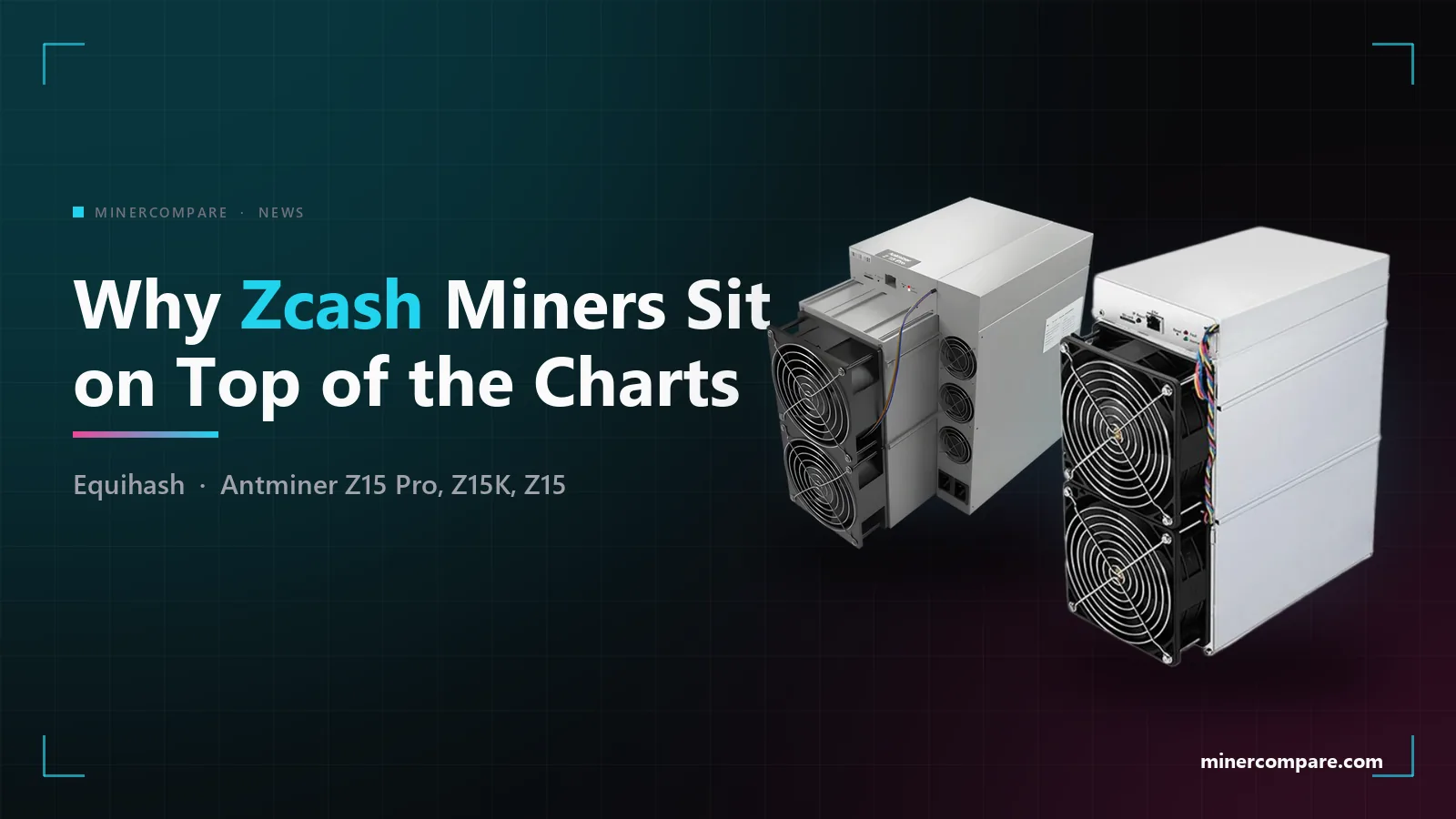
Open the ASIC profitability table on any day this month and the top row is not a Bitcoin miner. It is the Bitmain Antminer Z15 Pro on Equihash, with the Z15K and the original Z15 close behind it. This article explains why an algorithm that has not seen a new chip in years is leading the chart, what would end that run, and how to decide whether a Zcash miner belongs in your rack.
The setup: price ran, hashrate crawled
Mining profit per machine is a fraction: your share of the network hashrate, multiplied by the value of the block reward. The reward on Zcash is fixed at 1.25 ZEC per block until the next halving, so only two things move the fraction, the price of ZEC and the total hashrate competing for each block. In 2026 the price side moved much faster than the hashrate side, and that gap is the whole story.
The network did grow. Zcash was hashing around 8 gigasols per second in late 2025, close to 15 by April 2026, and was above 26 by the end of August, near its all-time high. That is more than a tripling in under a year. But the price of ZEC rose several times over in the same period, and every percentage point that price outruns hashrate shows up as a wider margin per machine.
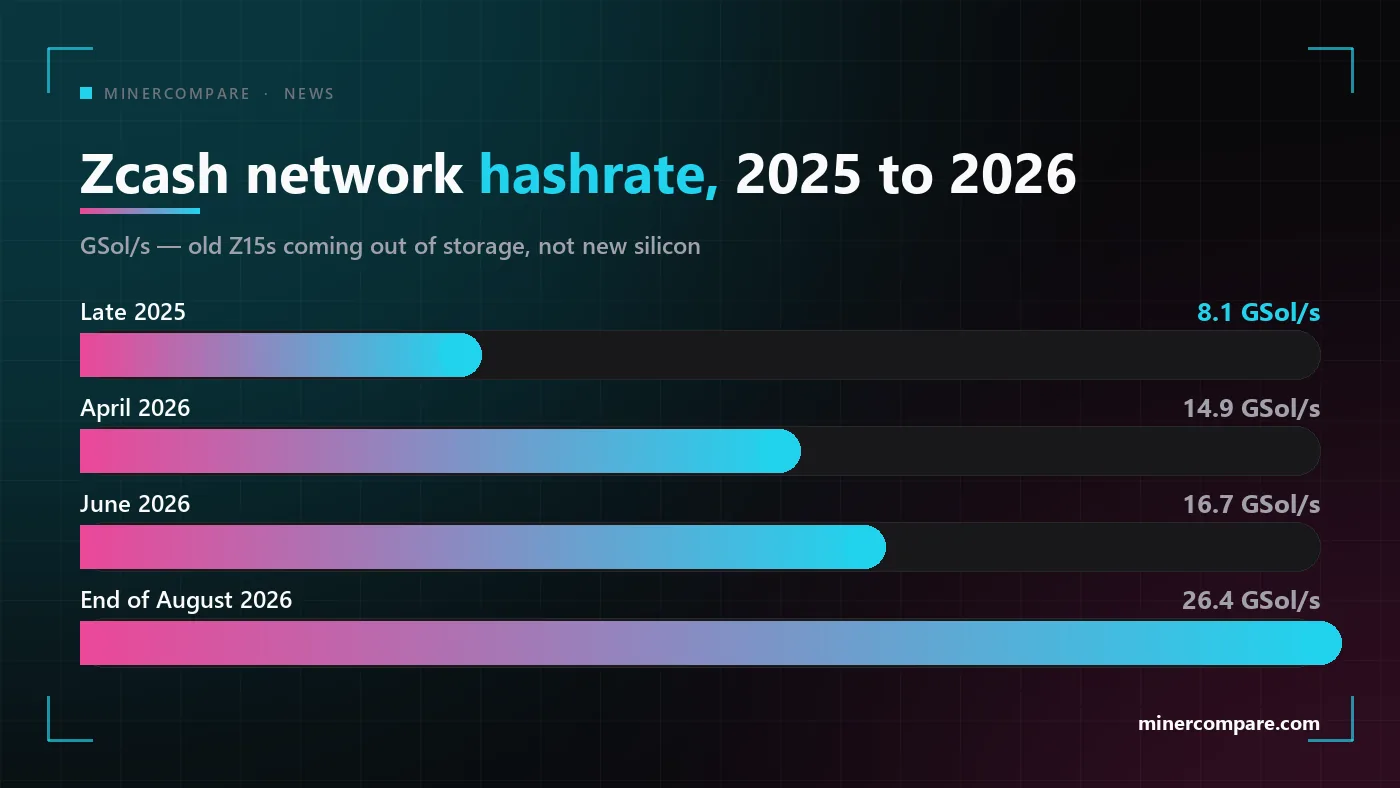
What makes the situation unusual is where the new hashrate came from. On SHA-256, a price rally is answered within a quarter by a flood of new, more efficient machines from three manufacturers, which pushes difficulty up and margins back down. On Equihash there is no flood to come. The hashrate that arrived this year is old Z15 units coming out of storage, being repaired, and being plugged back in. Once those are all running, there is nothing left in the warehouse.
Why Equihash is different
Equihash 200,9 is the memory-hard proof of work Zcash launched with in 2016. It was designed to resist ASICs and lasted about two years before Bitmain shipped the Antminer Z9 in 2018, followed by the Z11, the Z15 in 2020, and the Z15 Pro. Innosilicon built the A9 ZMaster line in the same period. Since then the algorithm has been a small, closed market: a few Bitmain models, no new entrants, and a manufacturer that has clearly decided the segment is too small for a new tape-out.
That has three consequences. The first is that efficiency is frozen; a Z15 Pro bought today is the same machine as one bought two years ago, and nothing coming will make it obsolete overnight. The second is that the total possible hashrate is capped by how many units exist. The third is that the second-hand market is the market: prices for used Z15s track the profit table with a lag of weeks, so the best time to buy is never the week the chart looks best.
The machines on the algorithm
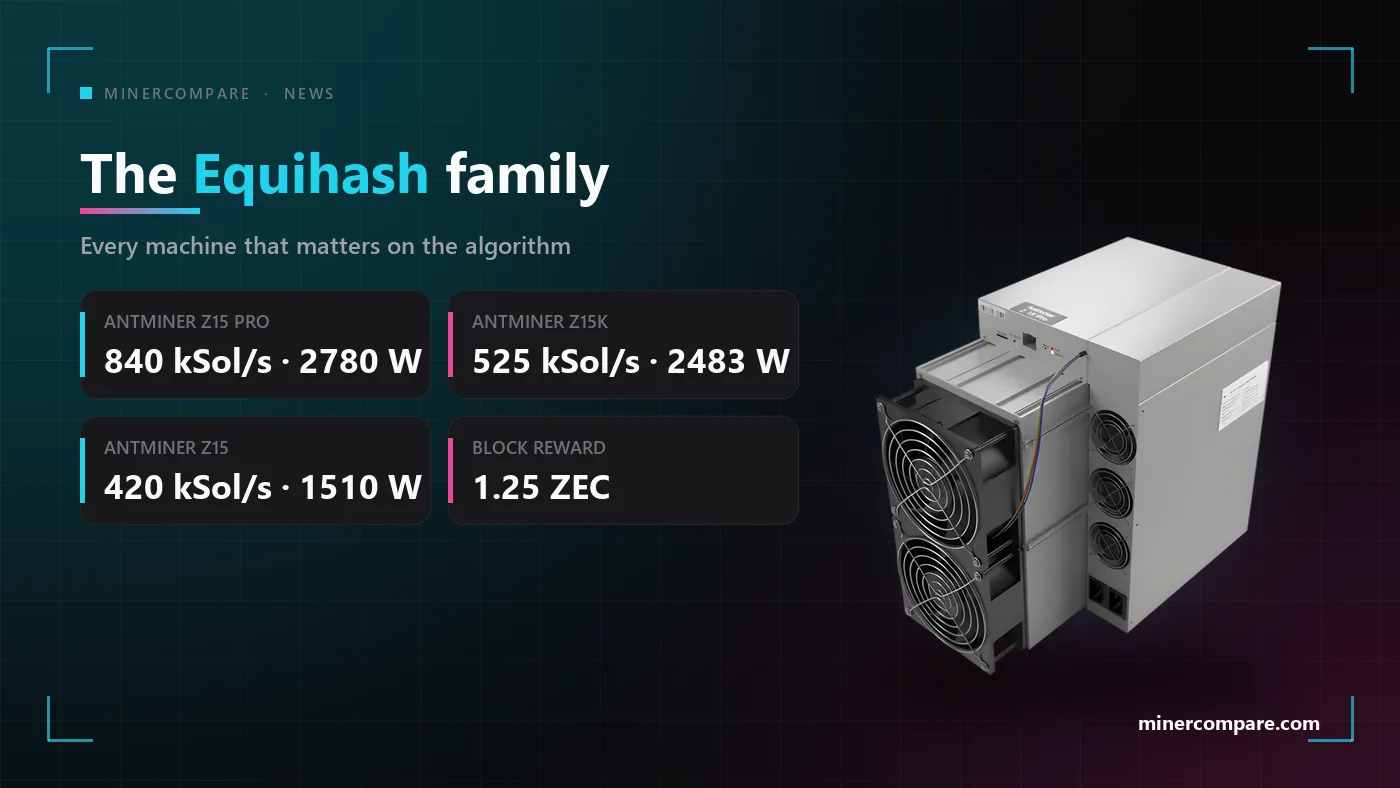
Three Bitmain units account for almost all of the Equihash hashrate that matters, and MinerCompare tracks each with live numbers and vendor offers.
| Miner | Hashrate | Power |
|---|---|---|
| Antminer Z15 Pro | 840 kSol/s | 2,780 W |
| Antminer Z15K | 525 kSol/s | 2,483 W |
| Antminer Z15 | 420 kSol/s | 1,510 W |
-
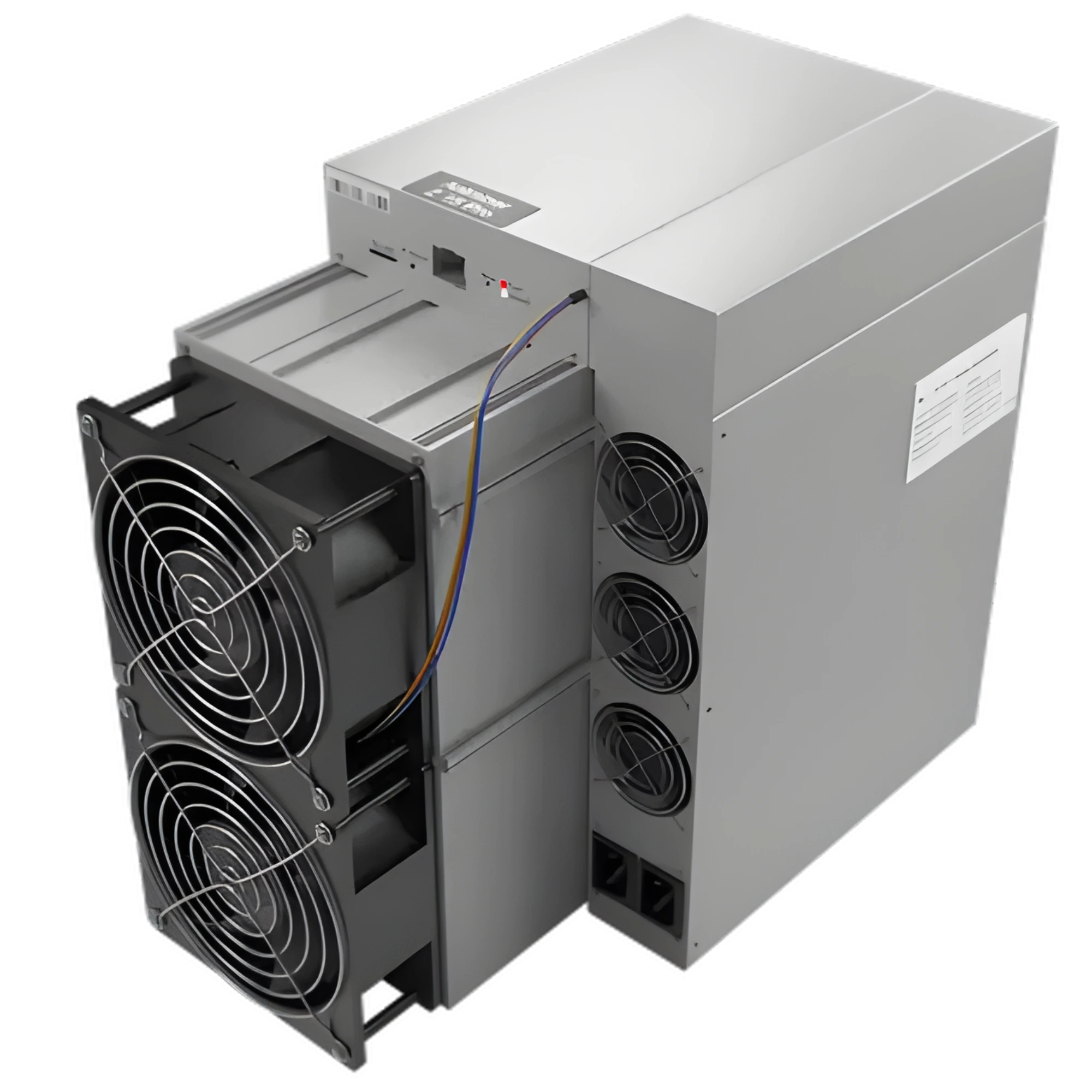 Bitmain Antminer Z15 Pro Zcash Miner Z15 Pro 840KSol
— the current flagship and the top of the whole ASIC table: 7 nm chips, integrated power supply, twice the hashrate of the original Z15.
Bitmain Antminer Z15 Pro Zcash Miner Z15 Pro 840KSol
— the current flagship and the top of the whole ASIC table: 7 nm chips, integrated power supply, twice the hashrate of the original Z15. -
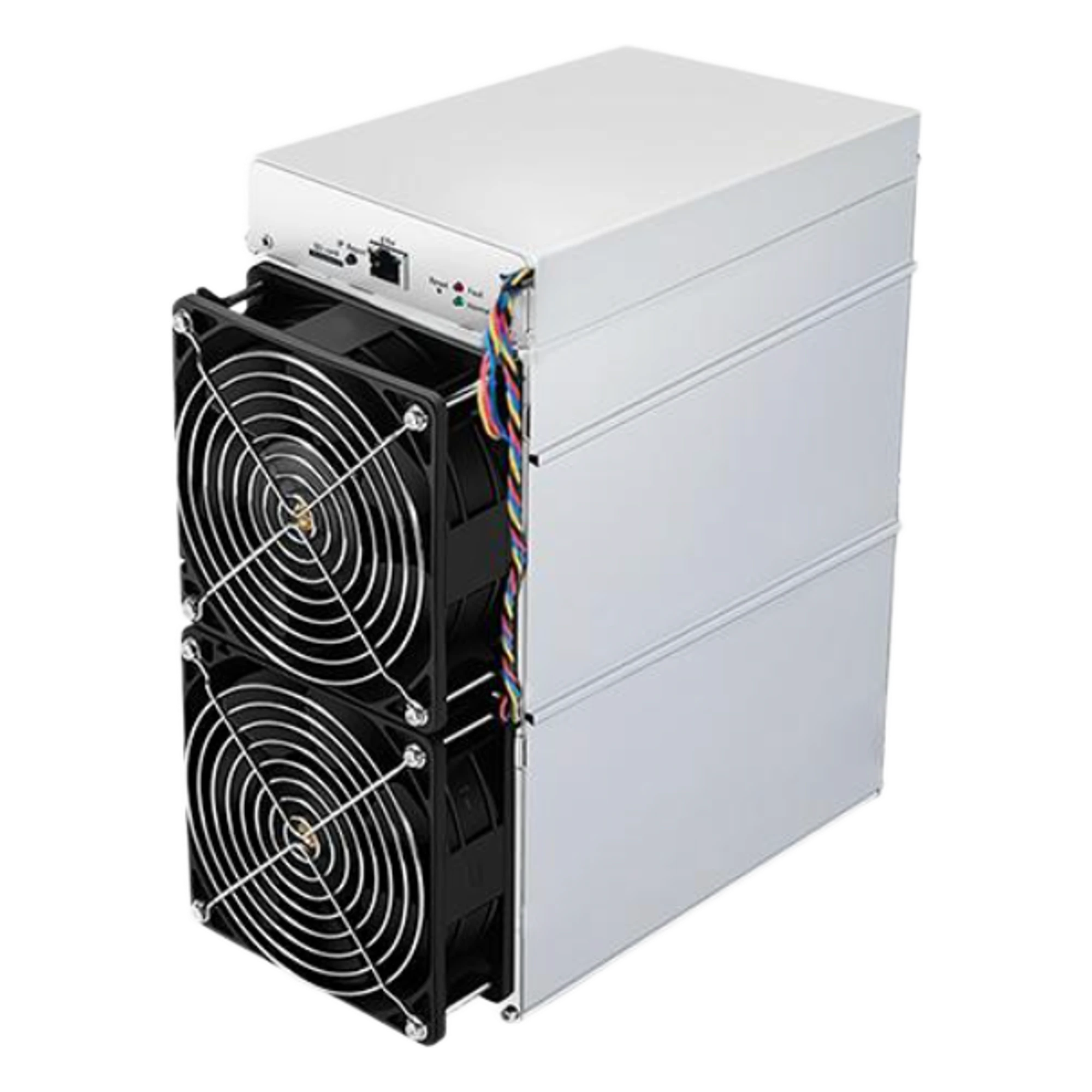 Bitmain Antminer Z15K (525KH)
— the middle child, a higher-clocked Z15 with more power draw for a quarter more hashrate.
Bitmain Antminer Z15K (525KH)
— the middle child, a higher-clocked Z15 with more power draw for a quarter more hashrate. -
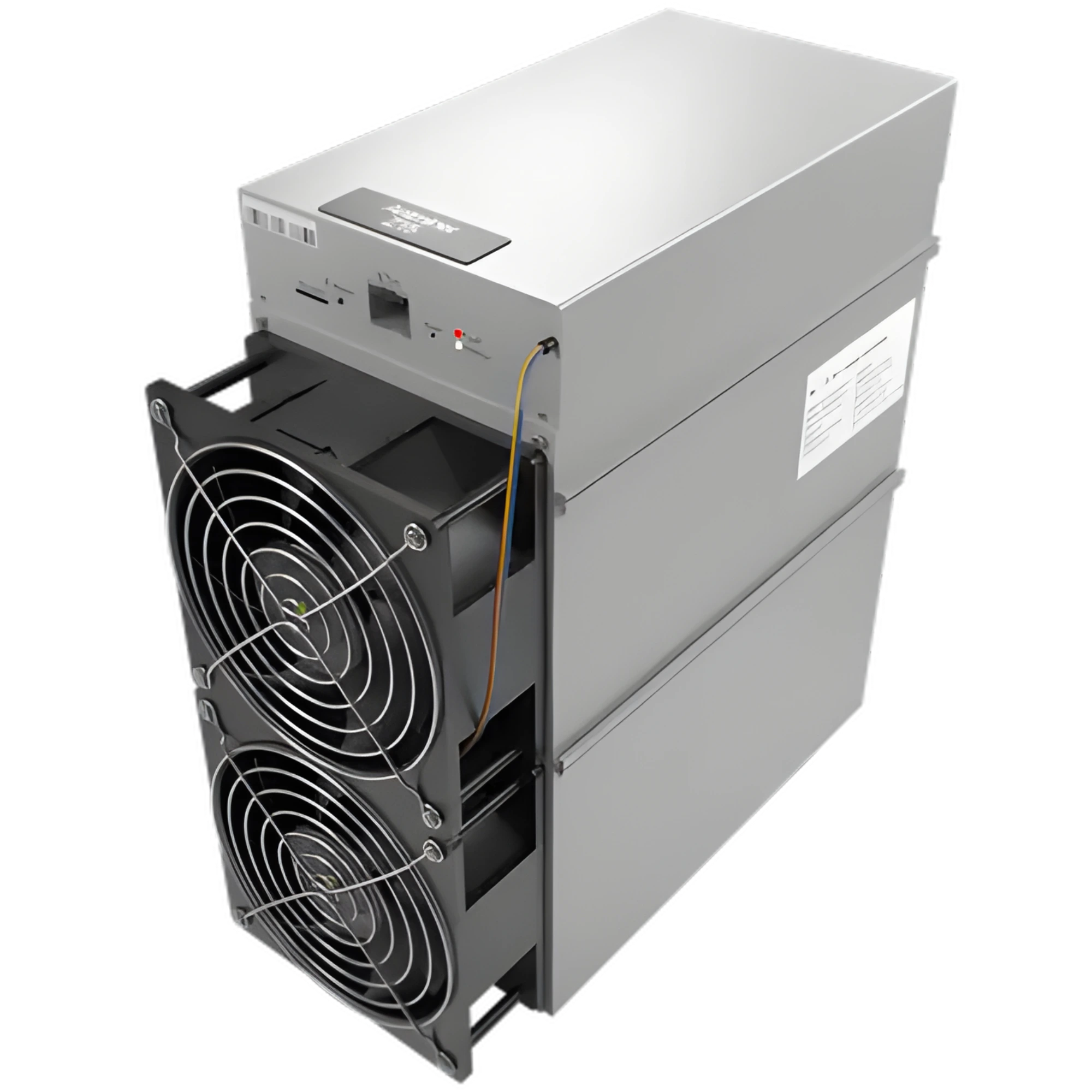 Bitmain Antminer Z15
— the 2020 original, the machine most of this year's new hashrate came from, and the one most often found used.
Bitmain Antminer Z15
— the 2020 original, the machine most of this year's new hashrate came from, and the one most often found used.
The older Z9, Z11 and Innosilicon A9 machines are also in the database, mostly because people still own them. At today's network they earn a fraction of what a Z15 Pro does per unit of electricity and only make sense where power is nearly free.
What ends a run like this
A margin created by price outrunning hashrate is closed by one of three things, and all three are visible in the calculator before they show up in your wallet.
Price
The rally is what opened the gap, and a retrace closes it just as fast. Zcash has always been a volatile coin, and its 2026 run has been driven by a narrative about shielded transactions and institutional interest that can reverse. If ZEC halves, so does every row on the Equihash table, and the Z15 Pro goes from the top of the chart to the middle without anything changing at the machine.
Hashrate
This one is already happening. Every dormant Z15 that gets plugged back in dilutes the reward per machine, and the network has tripled this year for exactly that reason. The question is how many are left in boxes. The realistic ceiling is a few times the current network, not the twenty-fold growth SHA-256 saw over its last cycle, because nobody is building new units. Difficulty has room to run before the Z15 Pro stops leading, but the direction is not in doubt.
Hardware prices
Second-hand Z15 prices react to the profit table within weeks. A machine bought at the peak of the chart is bought at the peak of its price, and the vendor selling it has read the same table you have. The offers block on each miner page shows what the market is asking today; watch how quickly those numbers move relative to the profit column and you will see the lag for yourself.
The neighbours on the chart
The Z15 Pro is not alone at the top. The rows directly below it are usually Monero machines on RandomX, the Antminer X9 and the Pinecone Inibox, for the same structural reason: a small, closed ASIC market on an algorithm designed to resist ASICs, where the price of the coin moved faster than the number of machines. Both algorithms share the pattern of long, flat hashrate curves punctuated by one manufacturer's release.
That is worth noticing because it tells you what kind of profit this is. It is not the profit of a better machine; a Z15 Pro is old technology. It is the profit of scarcity in the hardware market meeting a rally in the coin, and it belongs to whoever already owned the hardware when the rally started. Buying in afterwards means paying a price that already contains the rally.
Profit per day at your electricity rate, the coin breakdown, the historical trend and every vendor offer for the Z15 Pro and its siblings.
See every Equihash miner with live numbersShould you buy one?
Ask the calculator three questions before you ask a vendor, and be honest about the answers.
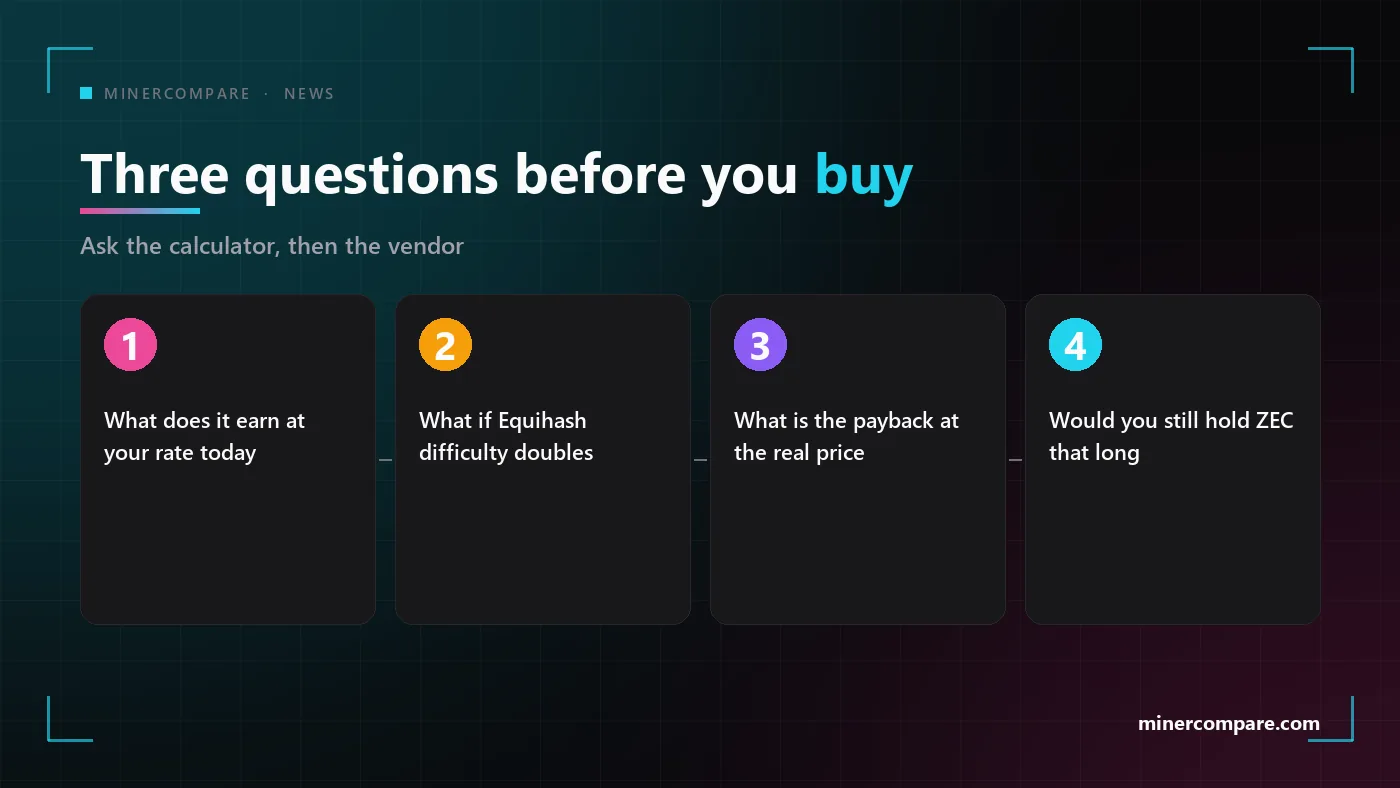
What does it earn at your rate today?
Enter your real electricity price on the Z15 Pro page. A 2.8 kilowatt machine at a European tariff loses a large part of its revenue to the wall before anything else is counted.
What happens if difficulty doubles again?
Roughly halve the profit figure. The network already tripled this year; another doubling is the conservative case, not the pessimistic one.
What is the payback at the price you can actually get?
Every vendor offer on the miner page shows its own payback period against today's profit. Use the delivered price, including shipping and duty, not the headline.
Would you hold ZEC that long?
If the payback is longer than the period you believe ZEC stays at this level, you are renting exposure to the coin, not buying a machine. That can be fine, as long as it is the decision you meant to make.
If the answers are good at your rate, at doubled difficulty and at the real delivered price, a Z15 Pro is a reasonable machine to own, and the fact that no successor is coming means it will not be made obsolete by a product launch. If the answers only work at today's difficulty and today's price, the chart is telling you about the past, not the future.
The three questions apply to every offer on the miner page, and the buying guide explains how those offers, delivered prices and payback periods are calculated. The Zcash coin page shows the live network hashrate and difficulty behind every row. Buying an ASIC Miner · Zcash coin page · Compare two miners
The same pattern of a small hardware base meeting a sudden demand is playing out on Blake2b right now, with old Sia miners instead of Z15s; and if you want the opposite end of the scale, the desk-sized Bitcoin lottery miners are the cheapest way into mining hardware there is. BTCB2 and the Blake2b rental rush · Bitcoin home mining with solo lottery miners
Bottom line
Zcash miners lead the profit chart because ZEC rallied while the Equihash network could only grow by digging old machines out of storage, and because the reward per block is fixed. That is a real margin, but it belongs to the people who already had the hardware. It narrows as the last dormant units come online, it vanishes if the price retraces, and it is already priced into what vendors ask for a used Z15.
If you own an Equihash miner, run it and enjoy the year. If you are thinking of buying one, run the three questions above with your own numbers, and treat the answer to the last one as the real one.