English
 German
 Hungarian
 Dutch
Dutch
 Spanish
 French
 Italian
 Czech
Czech
 Polish
 Greek
Greek
Every cycle produces a coin that turns a dormant algorithm into a gold rush. This time it is BTCB2, a Bitcoin-branded chain that switched its proof of work to Blake2b, the algorithm Sia ASICs were built for years ago. Within days, machines that had been unplugged since 2022 were the most requested rigs on the hashrate rental market, and a meaningful part of the Siacoin network had walked away. This article explains what happened, why the old hardware suddenly mattered, and how to think about it without becoming somebody else's exit.
What happened on 30 August
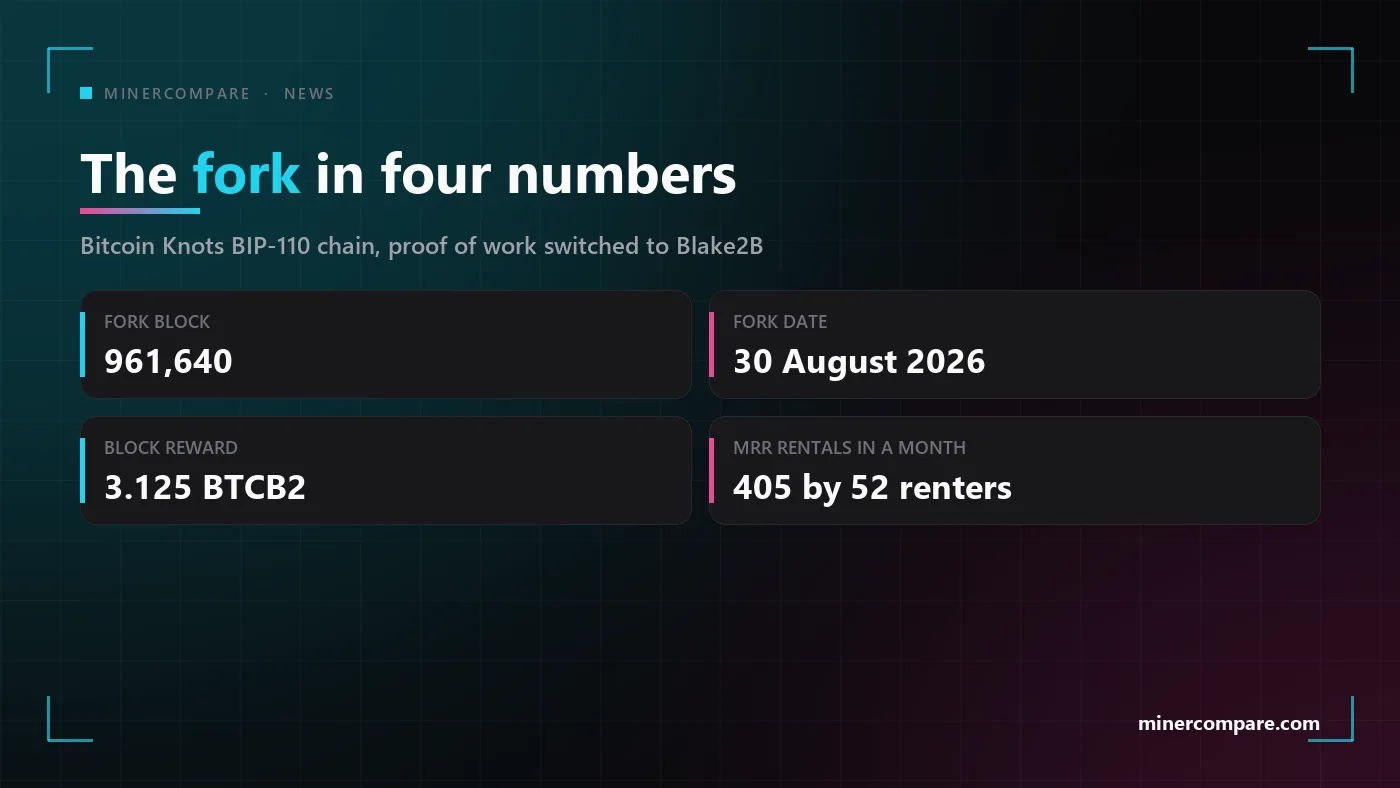
BTCB2 is the ticker attached to a chain that split from Bitcoin during the BIP-110 dispute in 2026. The two chains share history up to the split, so anyone holding BTC at that point held a matching balance on the new chain. On 30 August, at block 961,640, the Bitcoin Knots side of that split hard-forked its proof of work away from SHA-256d to Blake2b. The block reward stayed at 3.125 coins.
The stated reason was to escape the Bitcoin mining industry: with SHA-256 the new chain would have been trivially attackable by any large pool pointing a fraction of its hashrate at it for an afternoon. Changing the algorithm to one with a small, old, scattered hardware base made the chain harder to dominate and, as it turned out, handed a windfall to whoever still owned that hardware.
Why Blake2b, and why Sia hardware
Blake2b is the hash function Siacoin has used since 2015. It got ASICs in 2018, in the middle of the last hardware boom: the Obelisk SC1, Bitmain's Antminer A3, Innosilicon's S11, and later the Goldshell SC line and iBeLink's BM-S machines. Siacoin's price never justified most of them, and by 2022 the majority were in boxes, sold for scrap, or running in the few places where electricity is nearly free.
That is exactly the kind of hardware base a new chain wants. It is too small and too spread out for any one operator to attack the network, and it is idle, so it can be switched on without anyone building anything. The machines that matter today are the ones that were the best of their generation:
| Miner | Hashrate | Era |
|---|---|---|
| iBeLink BM-S3 | 19 TH/s | 2023 |
| Goldshell SC6 SE | 17 TH/s | 2022 |
| Goldshell SC5 Pro | 5.4 TH/s | 2021 |
| Goldshell HS5 (Sia mode) | 5.4 TH/s | 2021 |
| Bitmain Antminer A3 | 815 GH/s | 2018 |
None of these can mine Bitcoin, and no Bitcoin miner can mine BTCB2. The two hardware worlds are sealed off from each other by the algorithm, which is the whole design.
The hashrate rental rush
When a coin launches on an algorithm with idle hardware, two things happen at once. The people who own the hardware plug it back in, and everyone else discovers they can rent Blake2b hashrate by the hour on marketplaces like MiningRigRentals instead of buying a machine that has not been manufactured in years.
That second group is where the frenzy lives. Renting a few terahashes for the first days of a low-difficulty launch is the closest thing mining has to a free option: if the coin lists on an exchange, the early blocks were cheap; if it does not, the loss is a few hundred dollars of rental. In the month after the fork MiningRigRentals recorded roughly four hundred Blake2b rentals from about fifty renters, more than twenty rentals per rig on offer, and every new listing was taken within minutes.
The owners did well out of this. A Goldshell SC5 Pro mining Siacoin straight earns a few dollars of coins a day and burns more than that in electricity at most tariffs; renting it out during the rush paid many times its Siacoin income, and the renter carried the coin risk. That is the real story of the BTCB2 launch: it was not the miners who got rich, it was the landlords.
Where the Sia hashrate went
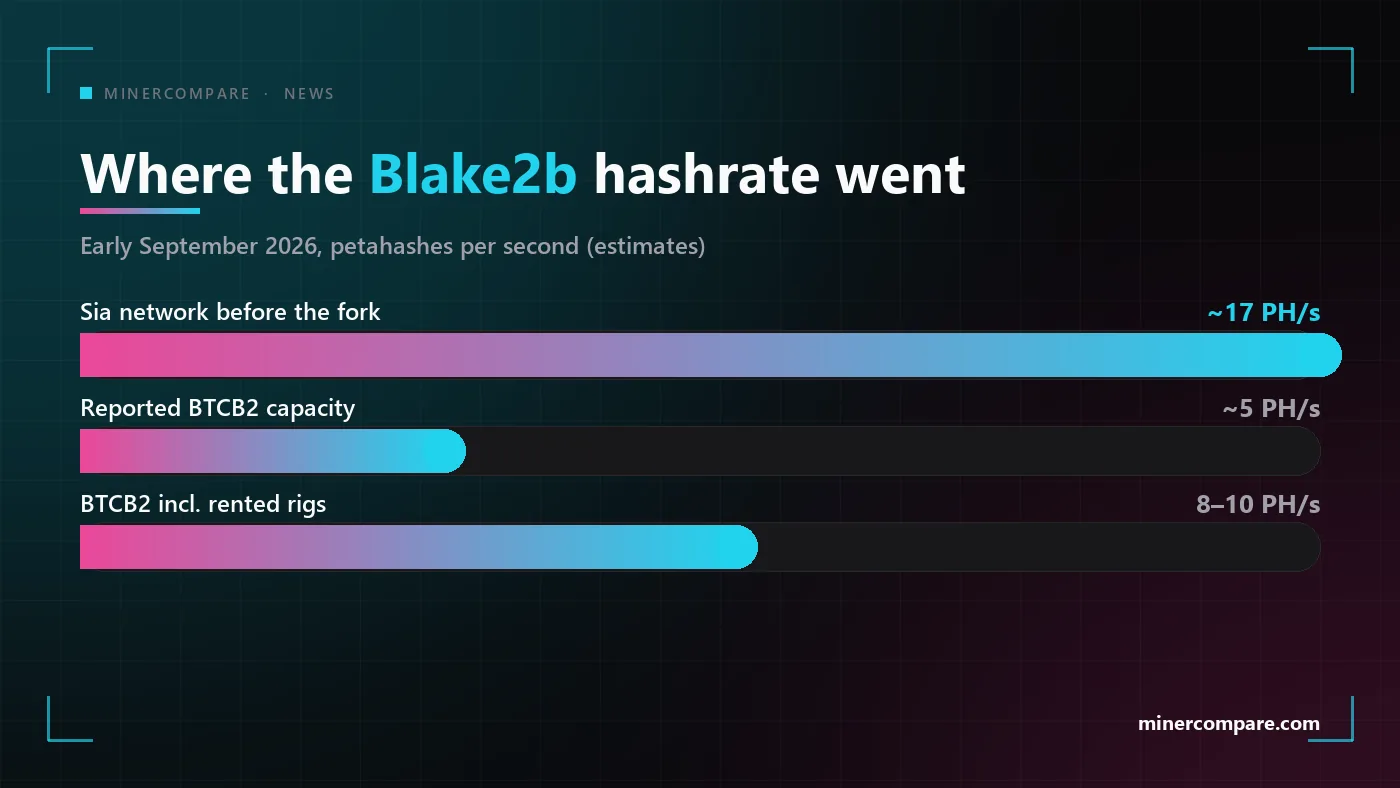
Siacoin was hashing around 17 petahashes per second in the months before the fork. In early September, reported BTCB2 capacity sat near 5 petahashes, with wider estimates of 8 to 10 once rented rigs are counted. Whichever number is right, somewhere between a third and a half of the Blake2b hashrate in the world had turned to face the new chain within two weeks, and most of it came out of the Sia network rather than out of storage.
For Siacoin that is the mirror image of the Zcash story: hashrate leaving while the price stays flat means every remaining Sia miner earns a larger slice of the same reward, and the Siacoin coin page reflects it immediately. For BTCB2 it means difficulty rose by orders of magnitude from launch, which is the normal life cycle of a launch on idle hardware: trivial on day one, saturated by day seven.
The Siacoin page shows live network hashrate, difficulty and what each listed Blake2b machine earns at your electricity rate.
See what Blake2b hardware earns on SiacoinThe three numbers that decide if it is real
Difficulty trajectory
A launch on idle hardware goes from nothing to saturated in days. Whatever an estimate said on day one, halve it for day seven and halve it again for the month.
Liquidity
A block reward is worth exactly what the first exchange pays for it. No listing, no price, no profit, only a balance in a wallet. Volume on a single small venue is not a price either.
Rental cost against expected reward
Rental is priced by the market, and the market reads the same estimates you do. When renting is obviously profitable, the rental price already reflects it.
These three are the same questions the calculator asks about every coin it lists, which is why BTCB2 is not listed: the first number is still moving fast, the second does not yet exist in a form we can trust, and the third is a bet, not a calculation.
How to play it without getting played
If you already own Blake2b hardware
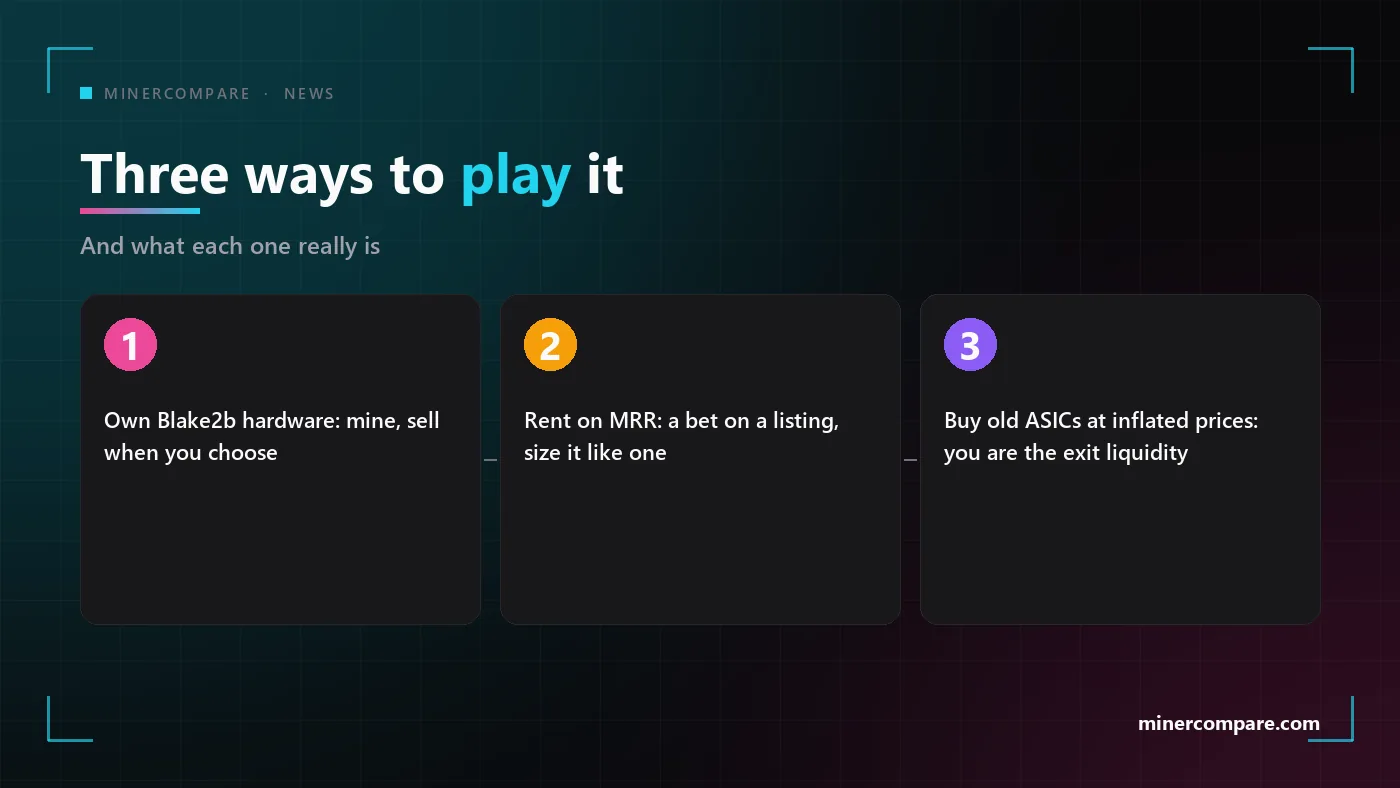
The maths is easy and the position is good. Electricity in, coins out, and you decide when to sell. Compare what the machine earns on Siacoin today against what a rental of the same hashrate fetches on the marketplace, and take the higher one; the rental income is real money while the BTCB2 income is a coin nobody has priced yet. If you mine BTCB2 directly, treat the balance as a lottery ticket until it has a market.
If you are renting
You are speculating on a listing, not mining. Size it like a bet: an amount you can write off entirely if the coin never trades. Rent for short windows, because difficulty moves against you every day, and stop when the rental price rises to meet the estimated reward, which it will.
If you are buying old Blake2b ASICs
The people selling them to you have read the same chart. Second-hand SC5 Pro and BM-S3 prices multiplied in the week after the fork, and a machine bought at that price needs the coin to list, hold a price and keep difficulty low for months just to return the purchase, before a single kilowatt-hour is paid for. If you want exposure to the coin, the cheapest way is to hold BTC through the next fork, not to buy a 2021 miner at a 2026 premium.
For machines that do have live numbers on a related algorithm, the Blake3 miners are listed with prices and offers on the ASIC list, our Zcash article explains the same dynamics of scarce hardware meeting a price move on Equihash, and the pools guide covers how payouts work when you do mine a listed coin. Blake3 miners · Why Zcash miners sit on top of the charts · Crypto mining pools explained
Bottom line
BTCB2 did not make Sia mining profitable; it made Sia hardware rentable. The chain switched to an algorithm whose only hardware was sitting idle, the people who owned that hardware became landlords for a month, and renters paid them to take the coin risk. Half of the Siacoin network followed the money, which made Sia itself a slightly better place to mine for everyone who stayed.
If you have the hardware, rent it or mine with it and sell the coins when there is a price. If you do not, the honest options are to rent a small, fixed amount as a bet, or to watch from the Siacoin page until the numbers are real enough to put in the calculator.