English
 German
 Hungarian
 Dutch
Dutch
 Spanish
 French
 Italian
 Czech
Czech
 Polish
 Greek
Greek
Short answer: no, not the way it was, and yes, for a specific kind of miner. GPU mining never fully left; it lost its flagship coin, most of its second-tier coins to ASICs, and the payback-in-months economics that made it a mainstream hobby. What is left is smaller, more speculative and, in 2026, slowly improving. This article looks at what the numbers say now, why they are creeping up, who should still do it, and how to do it without wasting electricity.
The short answer
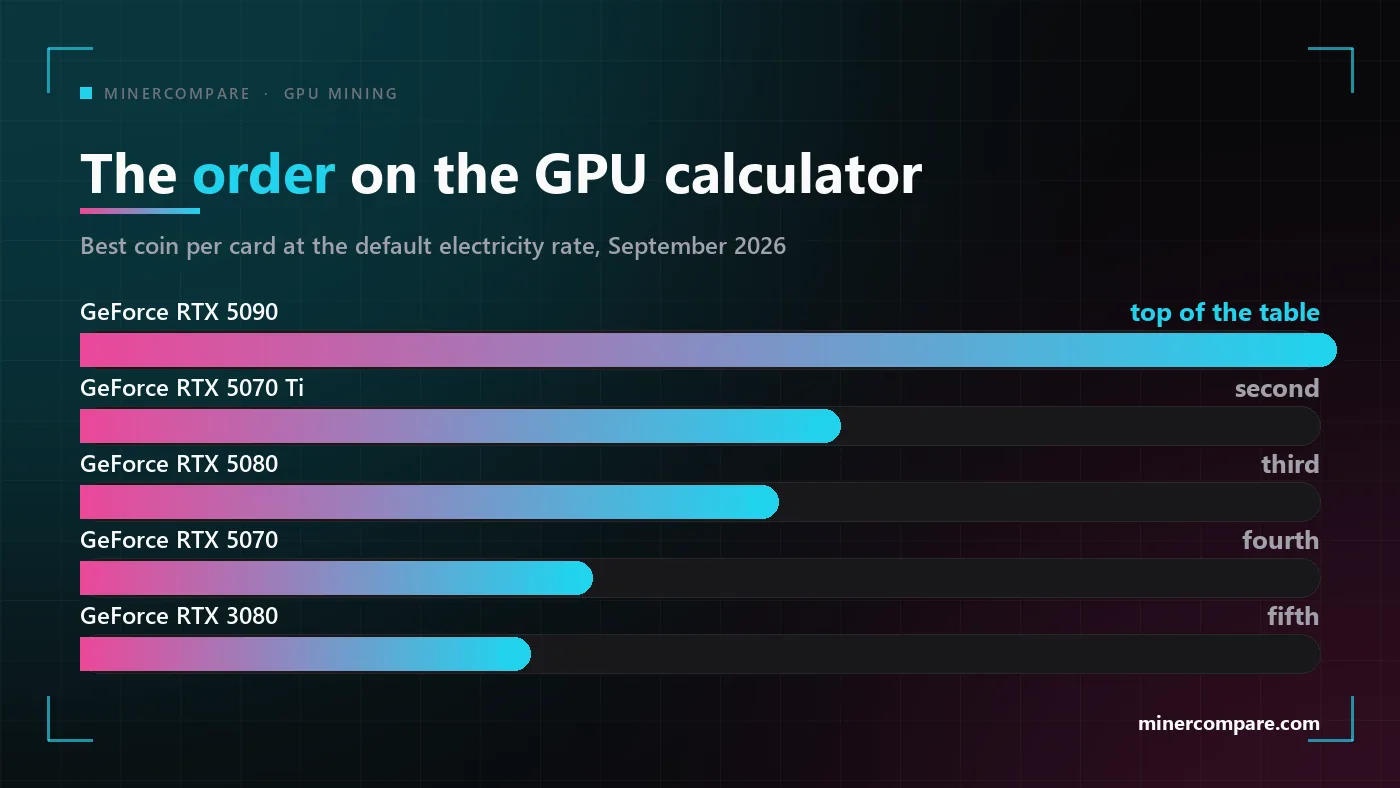
Open the GPU calculator at the default electricity rate and the order is clear: the GeForce RTX 5090 on top, then the RTX 5070 Ti, the RTX 5080, the RTX 5070 and the RTX 3080 class. The flagship earns low single-digit dollars a day on its best algorithm; everything below it earns less than a dollar. A card that costs a couple of thousand dollars and earns a dollar or two a day is a multi-year payback before difficulty moves, and difficulty always moves.
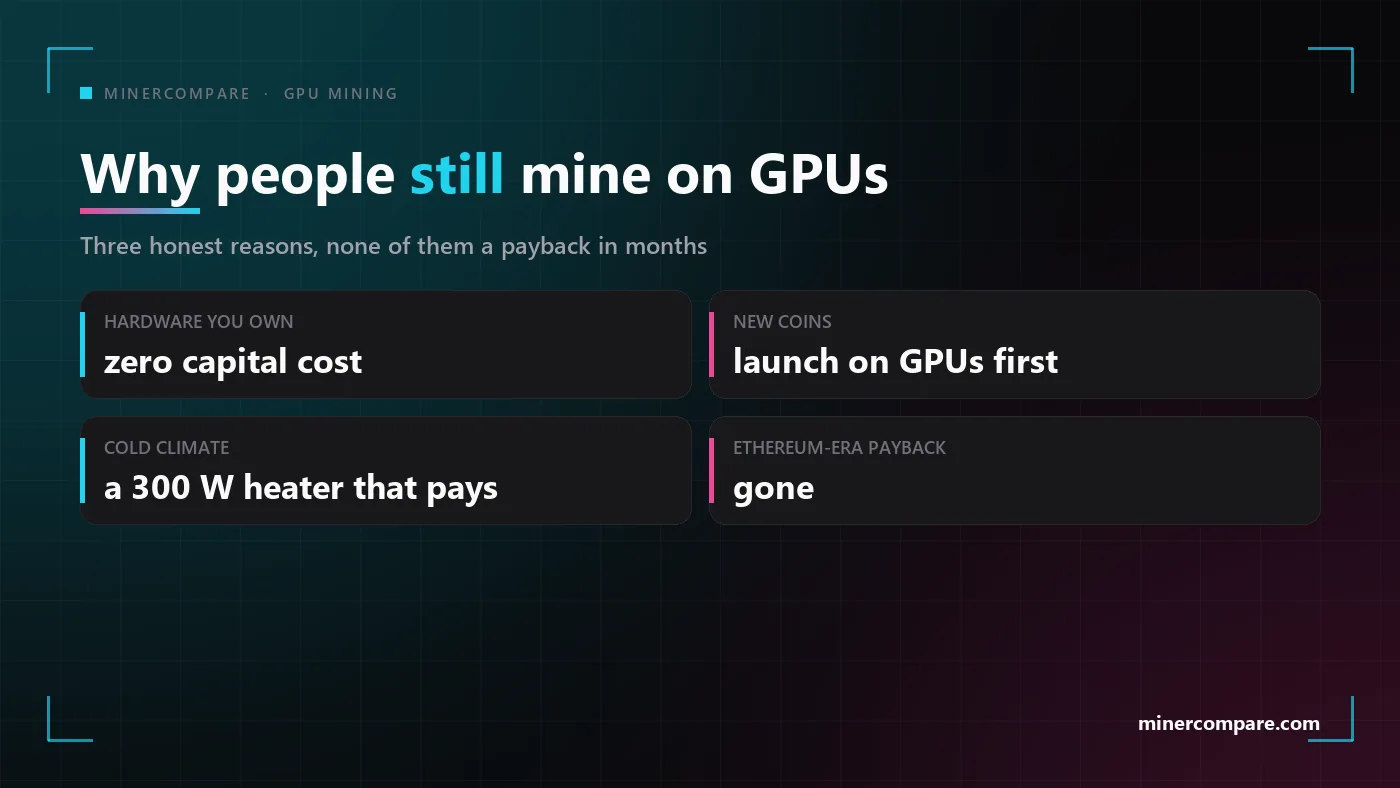
The top ASICs on the same site earn an order of magnitude more per machine. The Ethereum-era economics, a card paying for itself in months, are gone and are not coming back on any current coin. That is the honest baseline, and the rest of this article is about the exceptions.
What changed since 2022
Three things, and they all pushed the same way. Ethereum moved to proof of stake in September 2022 and took with it the one coin that could absorb the world's graphics cards at a profit. The memory-hard algorithms that were supposed to be the next home for GPUs, Kaspa and Alephium above all, were taken over by ASICs within two years of launch. And the cards themselves got more expensive per unit of hashrate: the RTX 5090 is a monster on paper and still earns less than a mid-range card did on Ethereum, because the coins it can mine are a fraction of the size.
What remains is a rotating cast of small-cap proof-of-work coins where the GPU mining community is the liquidity: Ravencoin on KawPow, Ergo on Autolykos, Conflux, Nexa, Karlsen and whatever launched last month. None of them can absorb much hashrate before the profit per card drops, which is why the table reorders itself every few weeks and why the most profitable coin for a card is a moving target.
Why the numbers are creeping up
The interesting part of 2026 is that the GPU rows have been drifting upward for several months. Nothing dramatic, but the flagship that earned around a dollar a day at the start of the year earns noticeably more now, and cards that were negative at a European tariff have crossed back to positive. Three forces are behind it.
The first is that a lot of GPU hashrate left. Every card that was sold, repurposed for AI inference or simply switched off when the numbers went negative is a card no longer competing for the same blocks, and difficulty on the remaining GPU coins fell to match. The second is that the small-cap coins rallied with the wider market this year, and a coin that doubles in price doubles every row on its algorithm. The third is that new algorithms keep launching on GPUs, and the first weeks of each one are the most profitable a card ever sees.
Who GPU mining still makes sense for
Hardware you already own
A gaming card that is idle at night has zero capital cost. A few dozen cents a night at a cheap tariff is beer money for doing nothing, and it is positive, which most old ASICs cannot say. If the card is already on the desk, the only question is whether the electricity rate leaves anything after the wall, and the calculator answers that per card.
New coins launch on GPUs
Every ASIC-resistant algorithm starts on graphics cards, and the people who are early to a launch are GPU miners by definition. It is speculative income rather than steady income, and most launches go nowhere, but that is where the upside in GPU mining has always lived. A miner with a few cards and the habit of checking the table weekly will catch two or three of these a year.
Heat
In a cold climate a 300 watt card is a space heater that pays you a little instead of costing you a little. That framing is more honest than profit, and for a home office in a northern winter it is the strongest argument on this list.
The cards at the top of the table
The order at the default rate is stable at the top and fluid below it. The flagship leads by a margin that reflects its raw compute; the mid-range cards trade places as the best coin for each one changes.
| Card | Rank | Note |
|---|---|---|
| GeForce RTX 5090 | 1 | Clear leader, highest power draw |
| GeForce RTX 5070 Ti | 2 | Best balance of price and output |
| GeForce RTX 5080 | 3 | Close behind the 5070 Ti |
| GeForce RTX 5070 | 4 | The efficiency pick |
| GeForce RTX 3080 | 5 | Best of the previous generation |
- GeForce RTX 5090 — the top of the whole GPU table on every algorithm it runs.
- GeForce RTX 5070 Ti — the card most people should look at first if they are buying anyway.
- GeForce RTX 5070 — the lowest power draw per unit of output in the current generation.
NVIDIA and AMD cards ranked by the best coin for each one, with power draw, the algorithm and the daily figure at your electricity price.
Every GPU ranked at your rateHow to do it right
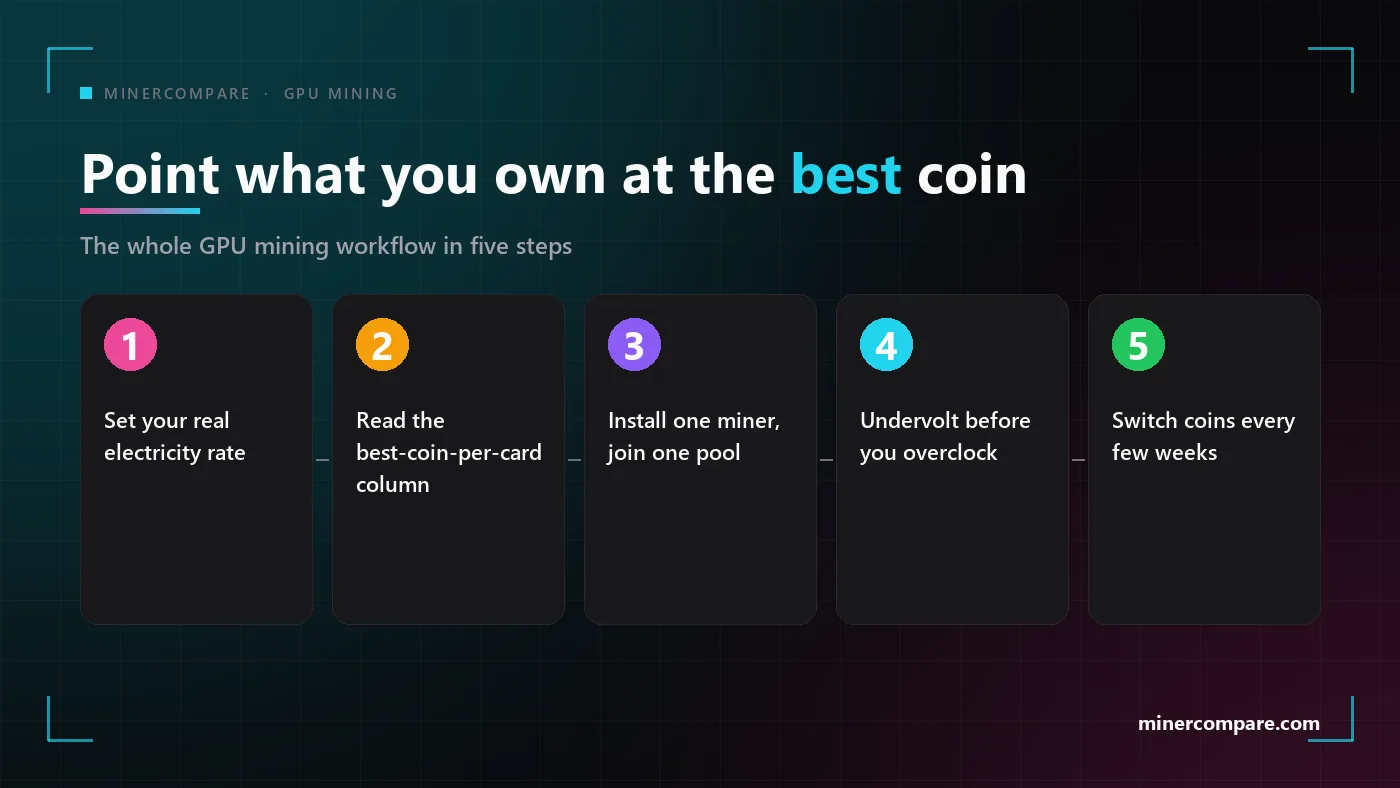
The workflow has not changed much in ten years; what has changed is that every step now matters, because the margin is thin enough that one wrong setting turns a positive card negative.
Set your real electricity rate
The default rate on any calculator is not yours. Enter the price on your bill, including taxes and network charges, before you read a single row. Half of the GPU table flips sign between 8 and 30 cents.
Read the best-coin-per-card column
Each card has a different best algorithm, and it is not always the one everyone is talking about. The calculator picks it for you; mine that, not the coin you like.
Install one miner, join one pool
One mining program for the algorithm, one pool with a published fee and a payout threshold you will actually reach. Avoid all-in-one launchers that add their own fee on top.
Undervolt before you overclock
Most cards lose a few percent of hashrate and a third of their power draw at a lower core voltage. That trade is the difference between positive and negative on almost every mid-range card.
Switch coins every few weeks
Check the table weekly. When the best coin for your card changes, change with it; the miners who stay on one coin out of habit are the ones whose profit quietly goes to zero.
The mistakes that cost money
- Buying hardware for it. A card bought to mine at 2026 prices needs the coin it mines to hold its price for years; the calculator shows the payback on each card and it is rarely under two years.
- Mining at stock power. The default power limit is tuned for games, not for running flat out for months. An undervolted card earns almost the same and costs a third less to run.
- Ignoring the pool fee and the payout threshold. A two percent fee on a card earning a dollar a day is invisible; a minimum payout you never reach is a hundred percent fee.
- Chasing every launch with every card. New coins are where the upside is, but most launches fail. Point one card at the launch and keep the rest on the best proven coin.
- Running in summer without checking. A card at 85 degrees throttles and earns less; a room at 30 degrees costs more to cool than the card earns. Set a temperature limit and let the miner idle when it is hit.
For the mechanics of pools and payout schemes read our mining pools guide; for the mirror image of this article, hardware whose numbers move only with the price of one coin, read why Zcash miners lead the ASIC chart this year; and if you want the smallest possible entry into ASIC hardware, the desk-sized Bitcoin lottery miners start where a single graphics card ends. Crypto mining pools explained · Why Zcash miners sit on top of the charts · Bitcoin home mining with solo lottery miners · All mineable coins
Bottom line
GPU mining in 2026 is a small, positive, slightly improving side income for people who already own a card and pay a normal electricity rate, and a speculative hobby for people who like being early to new coins. It is not an investment case, and no article claiming otherwise has done the maths at a real tariff.
Set your rate, look at the best coin per card, undervolt, and expect to switch coins every few weeks. Do not buy hardware for it. Do point what you have at the most profitable algorithm today, because for the first time in a while, today is a little better than last month.