English
 German
 Hungarian
 Dutch
Dutch
 Spanish
 French
 Italian
 Czech
Czech
 Polish
 Greek
Greek
For most of the last few years the honest answer to whether GPU mining pays was: barely. In October 2026 that changed, because two new coins, Pearl and Quantus, started paying graphics cards several times more than anything else, with the long-running Epic Cash in third place. This article explains the three coins, shows what the popular cards earn on each with our own data, walks through how to start, and is honest about why returns this high rarely last.
The short answer
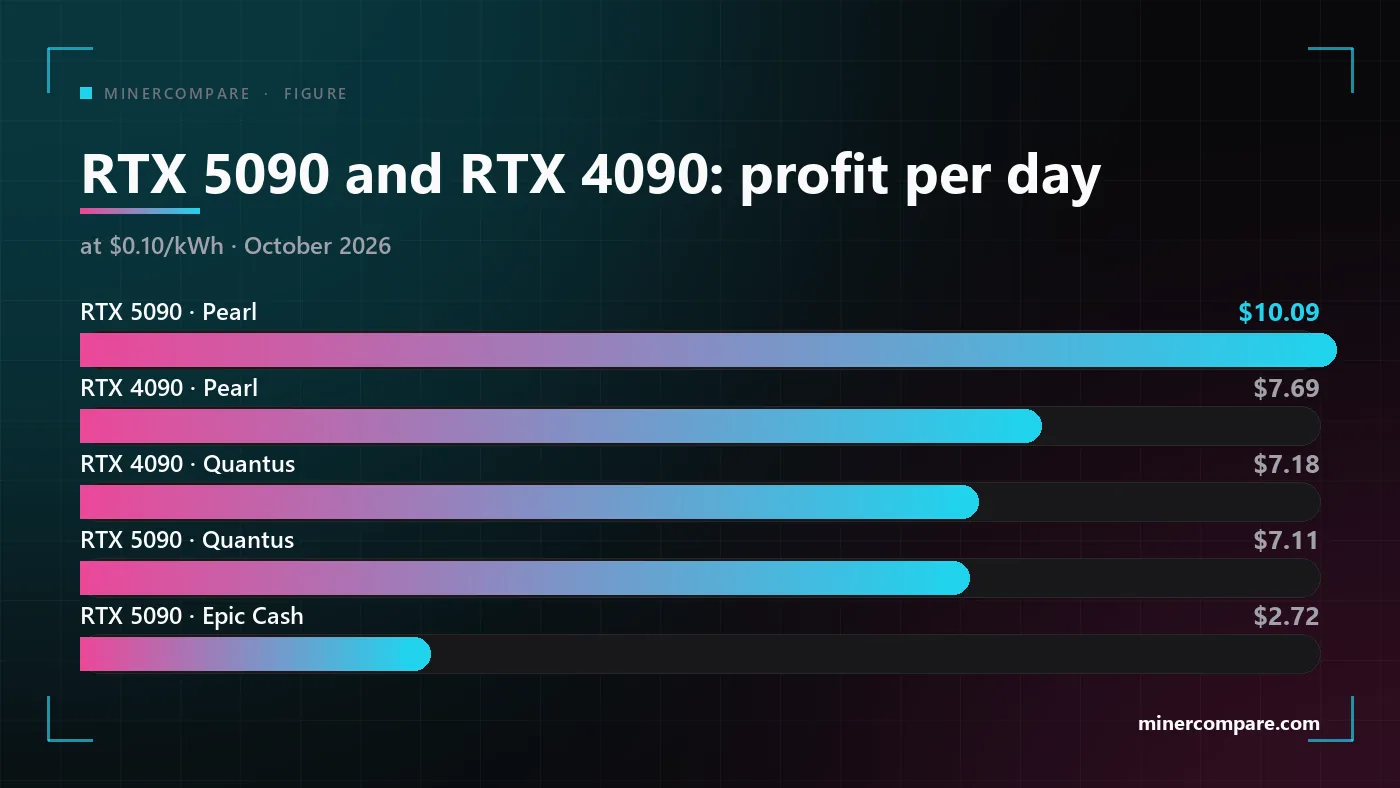
Yes, for recent NVIDIA cards, and by a wide margin. At a typical household electricity rate an RTX 5090 now earns about ten dollars a day after electricity, and an RTX 4090 more than seven. A few months ago the same cards earned two or three dollars on their best coin.
The change comes from two coins, not from the whole market. Pearl and Quantus pay three to four times what the best established GPU coin pays on the same card. Take them away and GPU mining is back to small daily amounts.
High early returns are normal for a new proof-of-work coin, and so is the decline that follows. Read every number here as what a card earns today, not as what it will earn next quarter.
The GPU ranking right now
This table is live. It is computed when the page loads from the same data as the GPU calculator: every card against its best coin, at the electricity rate and currency set in the header. If Pearl or Quantus is still the best coin for a card, you will see it in the third column.
| Rank | Card | Best coin | Power | Profit/day |
|---|---|---|---|---|
| 1 | GeForce RTX 5090 | Pearl Pearl · 417.89 TH/s | 519 W | $10.36 |
| 2 | GeForce RTX 5080 | Keryx KeryxHashH6 · 2.80 MH/s | 270 W | $9.97 |
| 3 | GeForce RTX 4080 Super | Keryx KeryxHashH6 · 2.50 MH/s | 330 W | $8.73 |
| 4 | GeForce RTX 4090 | Pearl Pearl · 308.21 TH/s | 280 W | $7.84 |
| 5 | GeForce RTX 4070 Ti Super | Keryx KeryxHashH6 · 2.00 MH/s | 280 W | $6.95 |
| 6 | GeForce RTX 5070 | Keryx KeryxHashH6 · 1.90 MH/s | 200 W | $6.73 |
| 7 | GeForce RTX 4070 Super | Keryx KeryxHashH6 · 1.70 MH/s | 240 W | $5.91 |
| 8 | GeForce RTX 4070 | Keryx KeryxHashH6 · 1.40 MH/s | 190 W | $4.88 |
| 9 | GeForce RTX 5070 Ti | Pearl Pearl · 170.62 TH/s | 169 W | $4.31 |
| 10 | GeForce RTX 4080 | Pearl Pearl · 168.00 TH/s | 260 W | $4.07 |
Profit is revenue on the best coin for the card minus electricity at the rate shown, before pool fees. The colour of the last column follows the same thresholds as the GPU table. Every GPU ranked at your rate →
Pearl: AI-style matrix maths as proof of work
Pearl replaces hashing with matrix multiplication. Where Bitcoin miners compute hashes, a Pearl miner multiplies large matrices on the GPU, commits to the result and attaches a proof that the network can check cheaply. The team calls the scheme NoisyGEMM, and the idea is that the same work could one day serve AI inference instead of being thrown away.
That is why tensor performance decides who wins. Classic GPU coins reward memory bandwidth or raw integer throughput. Pearl rewards the tensor cores that AI workloads use, so recent NVIDIA cards lead by a wide margin, the RTX 5090 first and the RTX 4090 a clear second, while AMD cards trail far behind.
- Mainnet launched in April 2026, and the chain is derived from Bitcoin's code base.
- Maximum supply is 2.1 billion coins, a hundred times Bitcoin's, with a block reward that declines over time.
- Blocks arrive every few minutes, so payouts come in larger, less frequent steps than on fast chains.
The coin page shows the network hashrate, block reward and price we use for every card. Open the Pearl mining calculator
Quantus: a post-quantum chain mined on QPoW
Quantus is built to survive quantum computers. Most blockchains sign transactions with elliptic-curve cryptography, which a large enough quantum computer could break. Quantus signs them with ML-DSA, the post-quantum standard published by NIST, so the coins are designed to stay safe even if that day comes.
Its proof of work is a plain GPU hash. Mining uses QPoW, a classic proof of work on the Poseidon2 hash, with blocks roughly every quarter of a minute and a supply capped at 21 million coins. Both NVIDIA cards from the RTX 3000 series on and AMD cards from the RX 6000 series on can mine it, with NVIDIA ahead on efficiency.
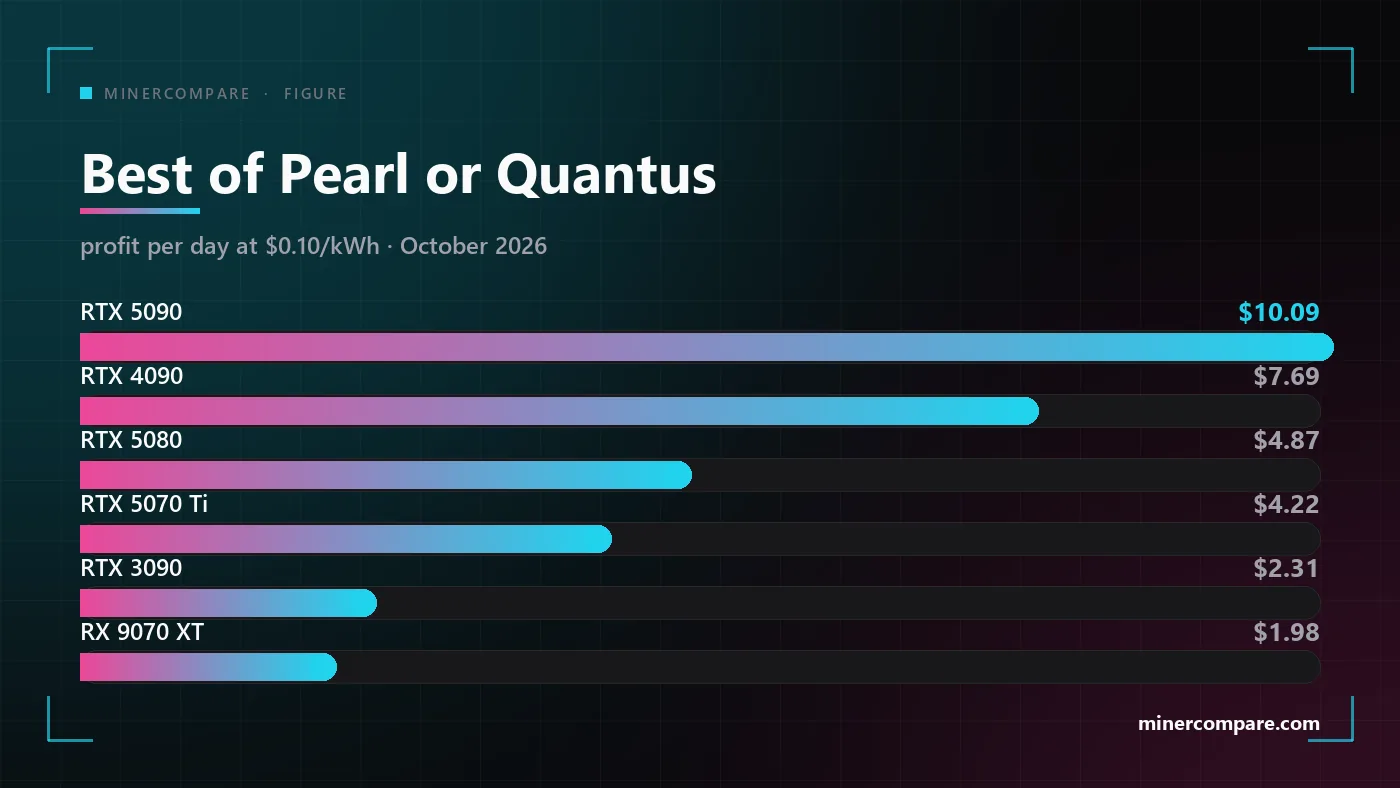
Quantus pays slightly less than Pearl on most cards, but it draws less power doing so, and on a few cards, the RTX 5080 and the RTX 3090 among them, it is the better of the two. Open the Quantus mining calculator
Epic Cash: the established third
Epic Cash is the best GPU coin that is not new. It is a privacy coin built on MimbleWimble that has been running since 2019, with a supply capped at 21 million coins and a block about every minute. Its blocks are shared between CPU miners on RandomX and GPU miners on ProgPow.
It pays far less than the two new coins, but it has a track record. On an RTX 5090 or RTX 4090 Epic Cash earns roughly a quarter of what Pearl pays. In exchange it has years of history, more places to trade and a network that does not change its rules every month, which makes it the fallback when the new coins cool down.
On some AMD cards, the RX 7900 XTX for example, Epic Cash still beats both new coins, because those cards are weak at the work Pearl and Quantus reward. Open the Epic Cash mining calculator
What each card earns on the top three
Here are the numbers behind the headline. The table shows our calculator's daily profit after electricity for popular cards in October 2026, at ten cents per kilowatt-hour. A dash means the card has no published hashrate for that coin.
| Card | Pearl | Quantus | Epic Cash |
|---|---|---|---|
| RTX 5090 | $10.09 | $7.11 | $2.72 |
| RTX 4090 | $7.69 | $7.18 | $1.91 |
| RTX 5080 | $4.69 | $4.87 | $1.90 |
| RTX 5070 Ti | $4.22 | $4.01 | $1.41 |
| RTX 4070 Ti Super | $3.91 | $3.64 | $1.17 |
| RTX 3090 | $2.22 | $2.31 | $1.15 |
| RTX 3060 | $1.02 | $0.95 | $0.57 |
| RX 9070 XT | $1.98 | $0.78 | — |
| RX 7900 XTX | $0.82 | $0.98 | $1.59 |
Your own figure depends on your electricity price, your card's tuning and the pool you use, so check the live number on the card page. See every coin for the RTX 5090 · See every coin for the RTX 4090
Why our numbers differ from other calculators
New algorithms get faster miners every few weeks. When Pearl and Quantus arrived, the published hashrates for many cards were already out of date: the miners had improved since the first measurements. Some calculators still listed the RTX 5090 below the RTX 4090 on Pearl, which no tested card shows.
So we checked every card against measured results. In October 2026 we compared our hashrate and power for Pearl, Quantus, Qubitcoin and Conflux with the benchmarks published by hashrate.no, card by card, and corrected every figure that was off by more than a small margin. Many cards gained ten to thirty percent on Quantus, several AMD cards gained much more on Pearl, and power came down for most of them.
The power figures for these coins are those of tuned cards, the way most miners run them. A card at stock settings will draw more and earn a little less than the table shows.
How to start mining them
Setting up takes about the same effort as any other GPU coin. You need a wallet address for the coin, a miner that supports its algorithm and a pool. The steps are the same for all three; only the algorithm name in the miner and the pool address change.
Check the numbers for your card
Open your card in the GPU calculator with your electricity price and see what each coin pays today.
Create a wallet
Use the official wallet of the coin and keep the recovery phrase offline. Mine to your own wallet, not to an exchange deposit address.
Install a miner
SRBMiner-MULTI mines Pearl and Quantus on NVIDIA and AMD; Epic Cash runs on the common ProgPow miners. Update your GPU driver first, because the newest NVIDIA cards need a recent one.
Pick a pool
Choose a pool with a low fee and enough hashrate for steady payouts, and point the miner at it with your wallet address.
Tune and watch
Lower the power limit until the hashrate starts to drop, then watch your daily profit on the card page and switch coins when the order changes.
If you are new to pools, fees and payout methods, our pool guide explains them in plain words. Read the mining pools guide
Why these numbers will not last
Every high-paying new coin attracts hashrate. Once a coin tops the calculators, miners switch to it and each card's share of the block reward shrinks. Pearl has already been through this once: reports from the summer describe its returns halving within weeks of launch as miners piled in.
The markets are thin. Pearl and Quantus trade mainly on a single small exchange, with little volume each day. A price quoted on such a market can fall sharply when miners sell what they mined, and the price you see on a calculator is not a guarantee that you can sell at it.
Young protocols change. New chains adjust their rules in their first year, and a change to the algorithm or the reward can move a card's earnings overnight. Follow the project's own announcements, not only the calculators.
The best time to mine a new coin is usually the first months, and the worst time to buy hardware for it is when it tops every list.
For the wider picture, these articles and tools go further: The best GPUs for mining in 2026 · How GPU mining came back after the Ethereum merge · How a coin profit calculator works · GPU mining calculator · All coins · Portfolio
Bottom line
GPU mining is profitable again, for now and for the right cards. If you already own a recent NVIDIA card, Pearl and Quantus pay several times more than anything a graphics card could mine earlier this year, and Epic Cash is a solid fallback. Mine to your own wallet, keep an eye on the card page and be ready to switch when the order changes.
Do not buy hardware on the strength of a launch-month number. The calculator shows what a card earns now; the trend of the last few weeks tells you more about what it will earn next.