English
 German
 Hungarian
 Dutch
Dutch
 Spanish
 French
 Italian
 Czech
Czech
 Polish
 Greek
Greek
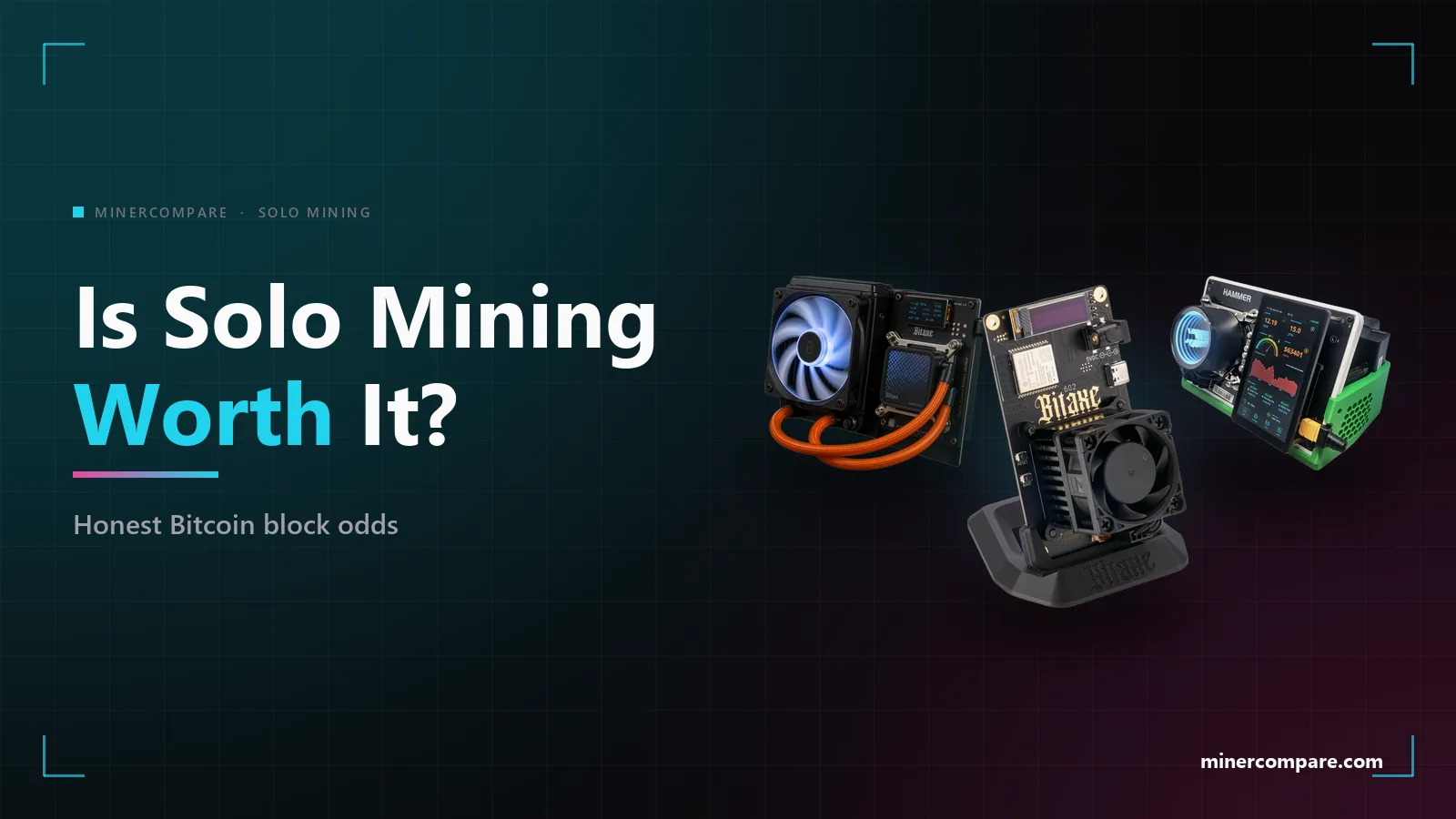
Is solo mining worth it? Honestly, it depends on what you expect from it. If you expect a paycheck, the odds say no. If you want a cheap lottery ticket that renews with every Bitcoin block, runs on a few watts and pays the whole block reward on the day it wins, the answer can be yes. This article puts real numbers on it, written as one in N and never as a promise: the odds for four machines, what they cost in electricity, how solo compares with a pool, and who should and should not buy one.
The short answer
Solo mining is worth it as a lottery ticket and a hobby, and never as income. A home solo miner earns nothing on almost every day of its life, and on one very unlikely day it is paid a full block reward. If that shape of outcome sounds fun to you, the cost of playing is small and known in advance.
The cost of the ticket is the electricity, plus the machine once. A desktop board draws about as much as a small LED bulb, so the yearly bill is a few tens of dollars. Nothing about the running cost is hidden, and nothing about it grows if you are unlucky.
If you want steady money from a miner, the same machine on a pool is the better tool. A pool pays small amounts often and takes a fee for it. Solo and pool have the same average outcome before fees, and the choice between them is a choice about how the money arrives, not how much of it there is.
What solo mining actually is
Bitcoin produces a new block about every ten minutes, and exactly one miner on Earth wins each one. Winning means being the first to find a hash below the current target, and every machine on the network is guessing at the same time. Your share of the guesses is your hashrate divided by the network hashrate, and that fraction is your chance for every block.
In solo mining you keep the whole block reward when you win and nothing when you do not. The reward is the block subsidy plus the transaction fees in that block, and it is paid to the Bitcoin address you mine with. The subsidy halves about every four years, which is one reason the prize is large and the wait is long.
Nothing about the process gets better with time spent. Each block is a fresh draw, so a machine that has run for a year without a win is no closer to one than on its first day. That memorylessness is the single most useful fact to hold on to before you buy.
The honest odds, in 1 in N terms
The table below is computed live from each hashrate against the current Bitcoin network. The daily and yearly columns are the chance of winning at least one block in that period, written as one in N. The last column is the average wait, which is a statistical average and not a promise that you will wait that long or even that short.
| Model | Hashrate | Daily block odds | Yearly block odds | Average wait for a block |
|---|---|---|---|---|
| Bitaxe Gamma 602 | 1.3 TH/s | 1 in 5.07M | 1 in 13.9K | ≈ 13,890 years |
| Bitaxe Gamma Hex | 8.4 TH/s | 1 in 785K | 1 in 2.15K | ≈ 2,150 years |
| HammerMiner BC08 | 12 TH/s | 1 in 550K | 1 in 1.51K | ≈ 1,510 years |
| Large ASIC miner | 200 TH/s | 1 in 33K | 1 in 91 | ≈ 90 years |
Read the yearly column first. It tells you how many years of continuous mining a given machine needs, on average, for one block to land. Even a large ASIC is a long shot over a single year, and a small desktop board is a long shot over a lifetime.
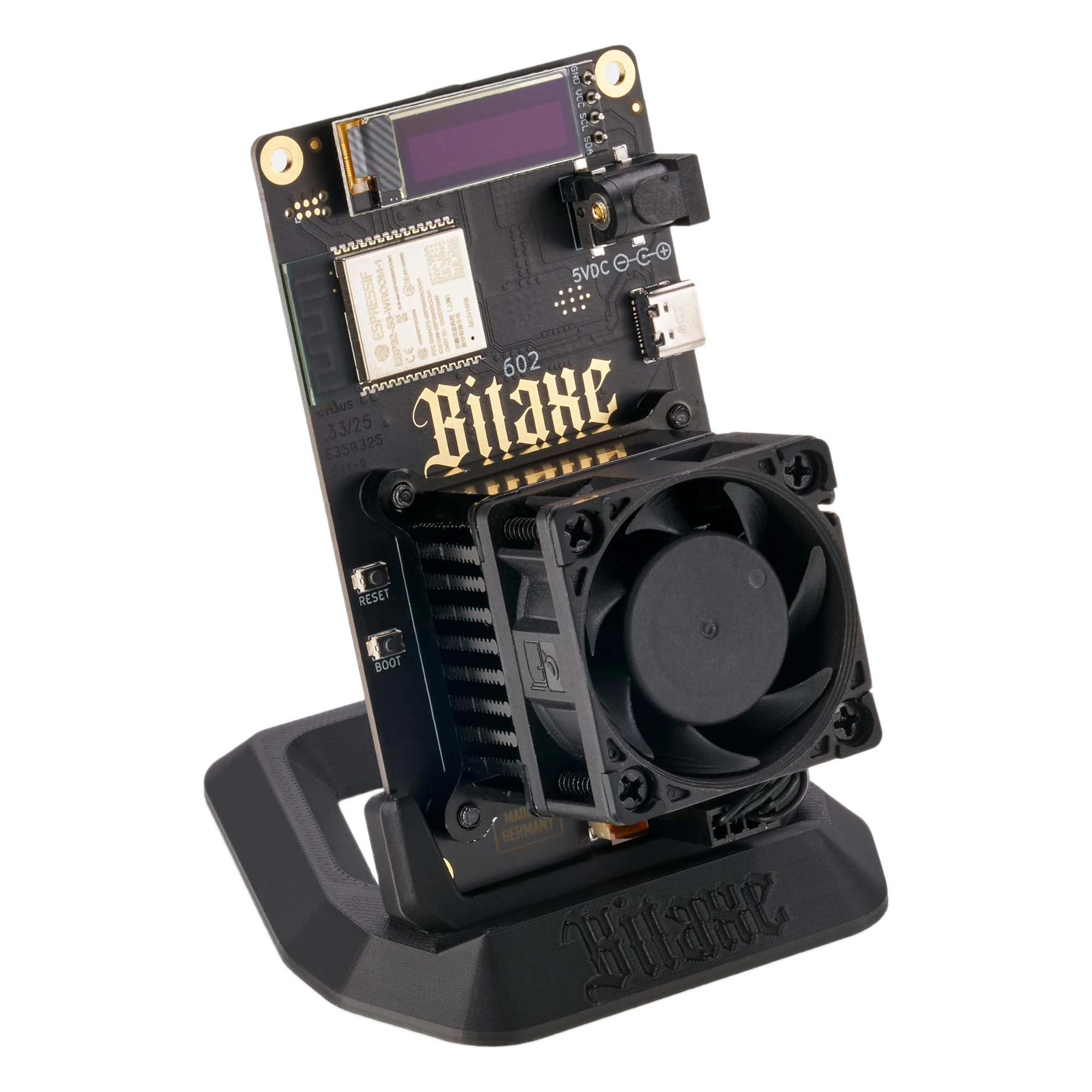 Bitaxe Gamma 602 (1.3TH)
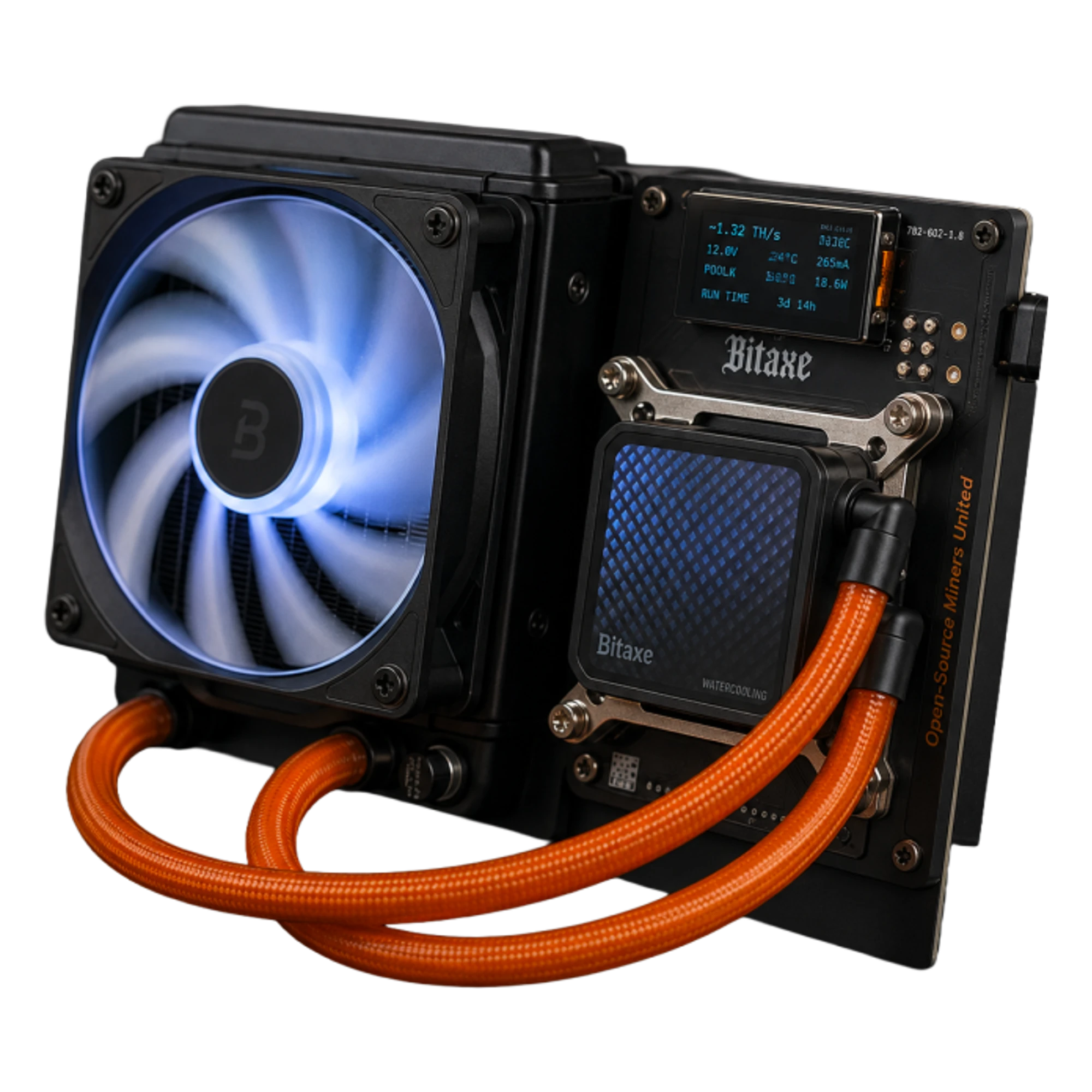 Bitaxe Gamma Hex (8.4TH)
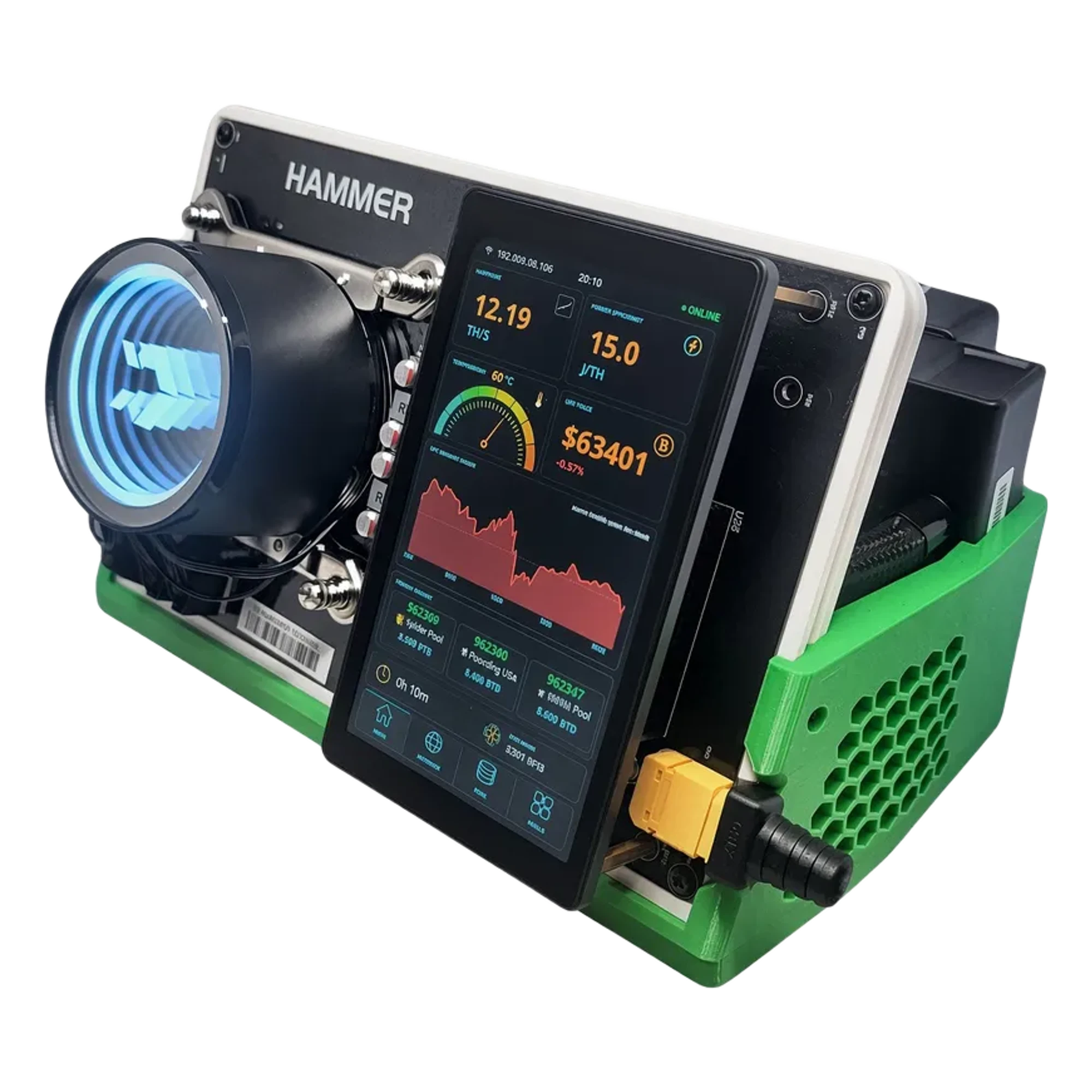 HammerMiner BC08 (12TH)
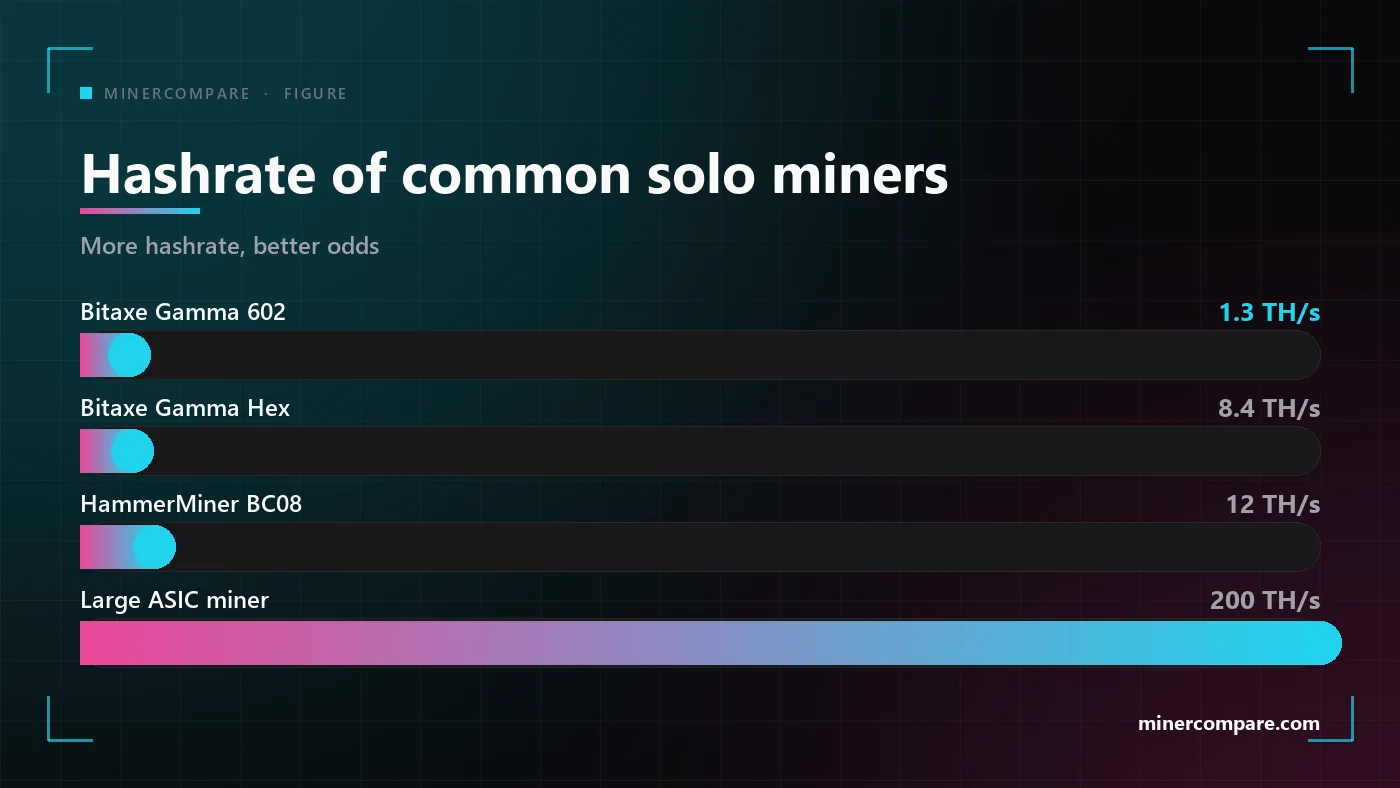
The same live odds exist for every lottery miner in our database. The ranking below lists the strongest ones, and the colour of the last column is the same daily-odds rating the solo lottery page uses.
| Miner | Hashrate | Power | BTC odds per day |
|---|---|---|---|
| NerdMiner NerdOCTAxe Rev 3.1 (12TH) | 12TH/s | 240W | 1 in 550K 1 in 1.51K / year |
| HammerMiner BC08 (12TH) | 12TH/s | 250W | 1 in 550K 1 in 1.51K / year |
| NerdMiner NerdOCTAxe (9.6TH) | 9.6TH/s | 160W | 1 in 687K 1 in 1.88K / year |
| Bitaxe Gamma Hex (8.4TH) | 8.4TH/s | 140W | 1 in 785K 1 in 2.15K / year |
| NerdMiner NerdQX (8TH) | 8TH/s | 170W | 1 in 825K 1 in 2.26K / year |
| HammerMiner Thor P2 (6.8TH) | 6.8TH/s | 155W | 1 in 970K 1 in 2.66K / year |
Odds are 1 in N against the live Bitcoin network difficulty; the smaller figure under each is the odds per year. See every solo miner with live odds →
Twice the hashrate is twice the chance, and nothing more mysterious than that. That is why buying a bigger machine improves the odds in a way no setting or trick can. It is also why the odds stay long for hobby hardware: the network is vast, and a single machine is a very small part of it.
What it costs to keep a ticket in the draw
The running cost of a solo miner is its electricity, and it is the same in a lucky year and an unlucky one. The table applies one fixed example electricity price to the power draw of each machine, shown in the column heading. Enter your own rate in the solo mining calculator to see the figure for your electricity.
| Model | Power | Electricity per month (0.10 USD/kWh) | Electricity per year (0.10 USD/kWh) | Yearly block odds |
|---|---|---|---|---|
| Bitaxe Gamma 602 | 15 W | $1.10 | $13 | 1 in 13.9K |
| Bitaxe Gamma Hex | 140 W | $10.22 | $123 | 1 in 2.15K |
| HammerMiner BC08 | 250 W | $18.25 | $219 | 1 in 1.51K |
Put the two right-hand columns together and you have the real trade: a known yearly bill against a yearly chance of a block. A machine that draws ten times the power costs ten times as much, and it only makes sense if the odds improve by a comparable factor.
Hardware is a one-off cost, and it is usually the smaller number over several years. Prices change from week to week, so check the vendors listed on each miner page for today's offers. A small desktop board costs about as much as a modest appliance, and the yearly electricity is what you keep paying after that.
Solo versus a pool
Before fees, solo and pool mining have the same average outcome. A pool combines the hashrate of thousands of miners, wins blocks regularly, and splits each reward by the work every member contributed. Over a long time your total is close to what the odds predict, and a pool is simply a way of collecting it in small pieces.
What differs completely is the spread of outcomes. A pool miner sees small payments on a regular schedule, minus the pool fee. A solo miner sees nothing for as long as it takes, and then, on the day of a win, the entire reward at once.
| Question | Pool mining | Solo mining |
|---|---|---|
| How often do I get paid? | Small payments, often | Almost never |
| How big is a payment? | A small share of a block | The whole block reward |
| Is there a pool fee? | Yes, on your regular payments | Usually none, or a small fee on a found block |
| What is it good for? | A predictable stream | A lottery ticket |
A common mistake is to treat solo as a pool that pays rarely. It is a different product: you are buying a chance at a very large prize and not a slow version of a salary. If the two outcomes are not equally acceptable to you, pick the one that is. Crypto Mining Pools
Who should do it, and who should not
You like the idea of a lottery ticket
Buy a small solo miner. For a few dollars of electricity a month you hold a real chance at a full block, and you can watch your shares arrive on the pool page.
You want to learn how Bitcoin works
A desktop solo miner is one of the cheapest ways to see blocks, shares, difficulty and pools first-hand. Few hobbies teach as much for so little power.
You want steady income
Do not buy a solo miner. Use a pool, or look at the live profit tables for ASIC miners, and accept that the margin depends on your electricity price.
You cannot afford to lose the money
Leave it. A solo miner has a known cost and no promised return, so only spend what you would be comfortable never getting back.
There is also a middle group: people who want a fun machine on the desk and a real, if tiny, chance. For them the choice of model is about electricity per ticket, which the cost table above makes easy to compare.
How to get the most out of your ticket
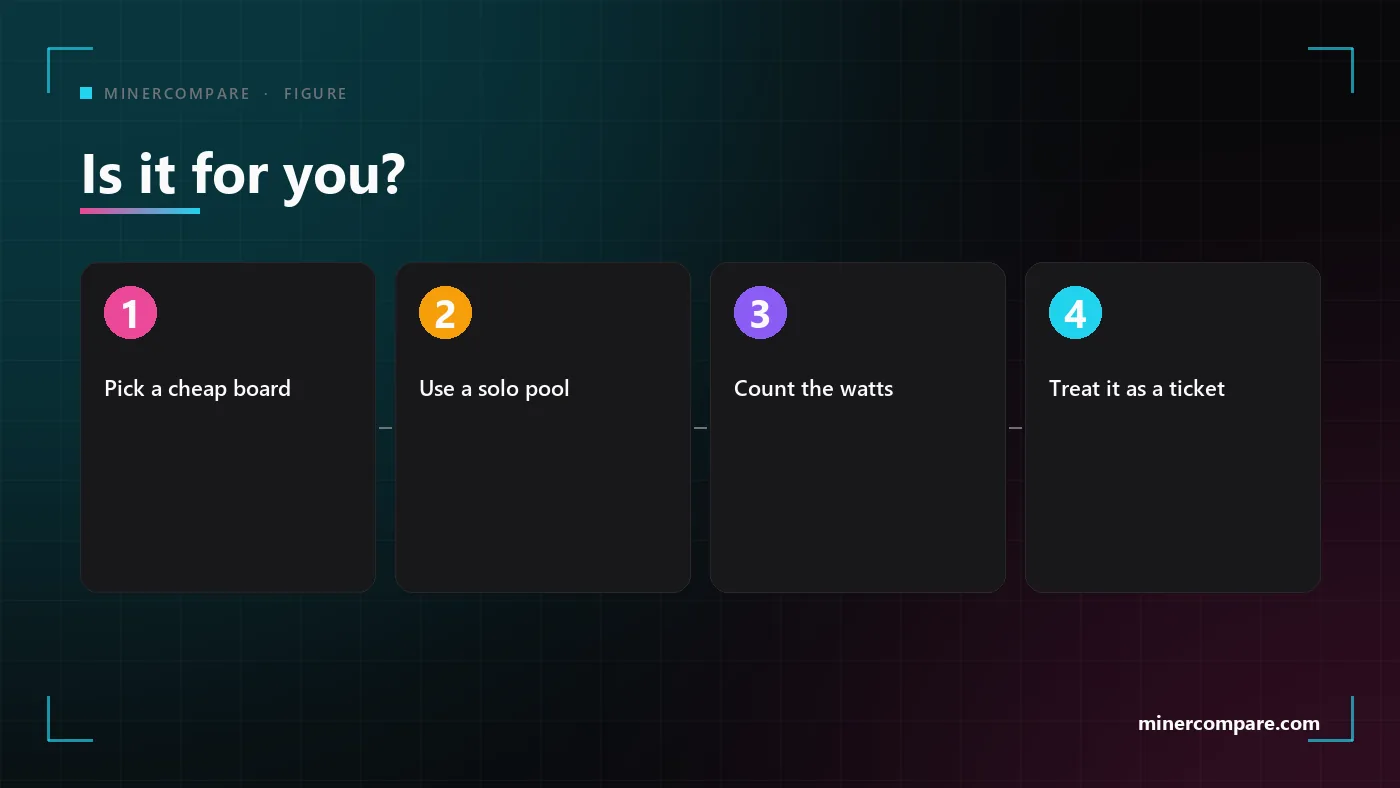
You cannot improve the odds with a trick, but you can avoid wasting them. These are the choices that matter, in order of how often they go wrong.
- Pick the machine with the cheapest watts per ticket. Compare hashrate against power on the miner pages. A machine that is twice as strong for twice the power buys the same odds per watt, and the one that is twice as strong for less than twice the power buys them cheaper.
- Keep it running. A ticket only counts while the machine is hashing, so a stable power supply, good cooling and a reliable connection are the cheapest way to improve your yearly odds.
- Use a solo pool whose difficulty floor fits your hashrate. A pool whose starting difficulty is too high for a small board shows you nothing on its dashboard, even though the machine is working. Our pool guide lists the settings that suit a desktop board.
- Mine to your own Bitcoin address. A found block is paid to the address in your settings, so it must belong to a wallet you control. Check it twice, because a typo cannot be undone.
- Optionally, run your own node. This does not change the odds, but it removes the pool operator from the path between your miner and the network. It is a project for the curious and not a requirement.
Our solo mining calculator takes your own hashrate and power and shows the odds per day, month and year, so you can test a machine before you buy it. Solo Mining Calculator: Block Odds for Your Miner
What a win looks like
When a solo miner wins, the whole block reward goes straight to the address you mine with. It is the block subsidy plus the transaction fees of that block, paid in a single transaction with no sharing and no waiting for a payout schedule. A solo pool may keep a small fee from it.
Like every newly created block reward, those coins can only be spent after 100 further blocks have been mined on top of yours, which takes about a day. Until then they are yours, and they are simply not yet movable.
The prize is real, the odds are honest, and the only thing a solo miner ever sells you is the chance.
The reward is large enough to be worth planning for, even if you never need the plan. Keep your wallet backup safe from the first day, and treat the address in your miner settings as the one that matters.
These articles and pages go deeper on the machines, the pools and the odds. Bitaxe Gamma 601 vs 602 vs Turbo: Which Solo Miner Should You Buy? · Solo Mining Bitcoin With a Bitaxe: Low-Difficulty Pools, Primary and Backup Settings · Bitcoin Home Mining in 2026: How Solo Lottery Miners Work and Which One to Buy · Solo Lottery Mining Beyond Bitcoin: BTC, BCH and LTC + DOGE Dual Solo Mining Setup Guide · How to Set Up an ASIC Miner: Power, Network, Pool and Cooling, Step by Step · Compare Miners · Bitcoin coin page · Mining Guide
The solo lottery page lists every lottery miner we track for both algorithms, rated by daily block odds, with your electricity rate applied as the yearly ticket price.
See every solo miner with live oddsBottom line
Solo mining is worth it only if you want the ticket. The odds are long, the electricity is cheap and known, and the prize is a full block reward. If that is the deal you want, buy a machine with good hashrate per watt and keep it online.
If you want income instead, use a pool, and expect the margin to depend on your electricity price. Whichever you choose, read the live odds on this site first, because they are the only honest answer to the question in the title.